
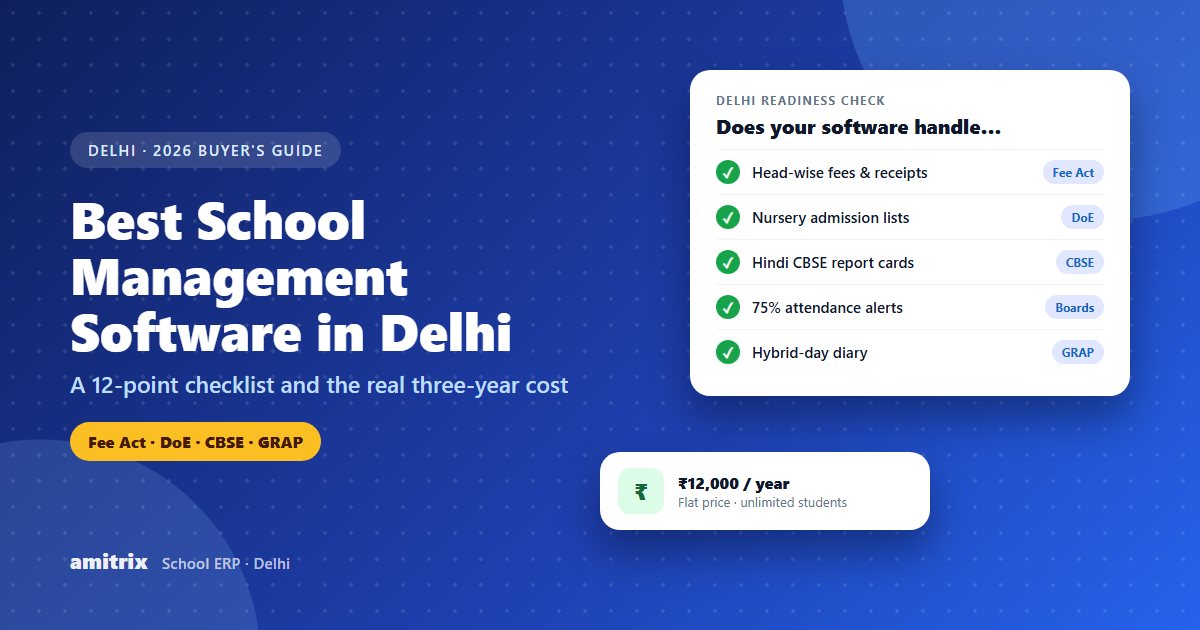
Choosing the best school management software in Delhi is not the same as choosing it anywhere else in India. A school in Rohini or Mayur Vihar has to run nursery admissions on the Directorate of Education's timeline, explain every fee head to a parent committee under the 2025 fee law, keep board-class attendance above 75%, and switch to hybrid classes overnight when a GRAP order arrives.
Most "top 10 software" lists ignore all of that. They compare features that every product already has.
This guide does the opposite. It sets out what a Delhi school actually needs from its software in 2026, the questions that separate a good system from a sales demo, and what the different pricing models really cost over three years.
Why Delhi Schools Need a Different Checklist
Four things make the Delhi school year unusual:
- Entry-level admissions follow a fixed DoE calendar. Nursery, KG and Class 1 applications, points and lists all run to dates set by the Directorate of Education, usually from late November to March.
- Fees are now regulated in detail. The Delhi School Education (Transparency in Fixation and Regulation of Fees) Act, 2025 brings a school-level fee committee with parents on it, caps several one-time charges and requires audit-ready records.
- Pollution orders change how classes run. Under GRAP Stage III and IV, schools have had to move several classes to hybrid mode at very short notice.
- Most private schools are CBSE-affiliated, and many families read Hindi more comfortably than English.
The Directorate of Education publishes the admission schedules and fee orders for private schools on its official website, and the Commission for Air Quality Management announces GRAP stages at caqm.nic.in. Any software you choose has to keep up with both.
Software that handles these four well will save your office weeks every year. Software that doesn't will leave you with spreadsheets running alongside an expensive system.
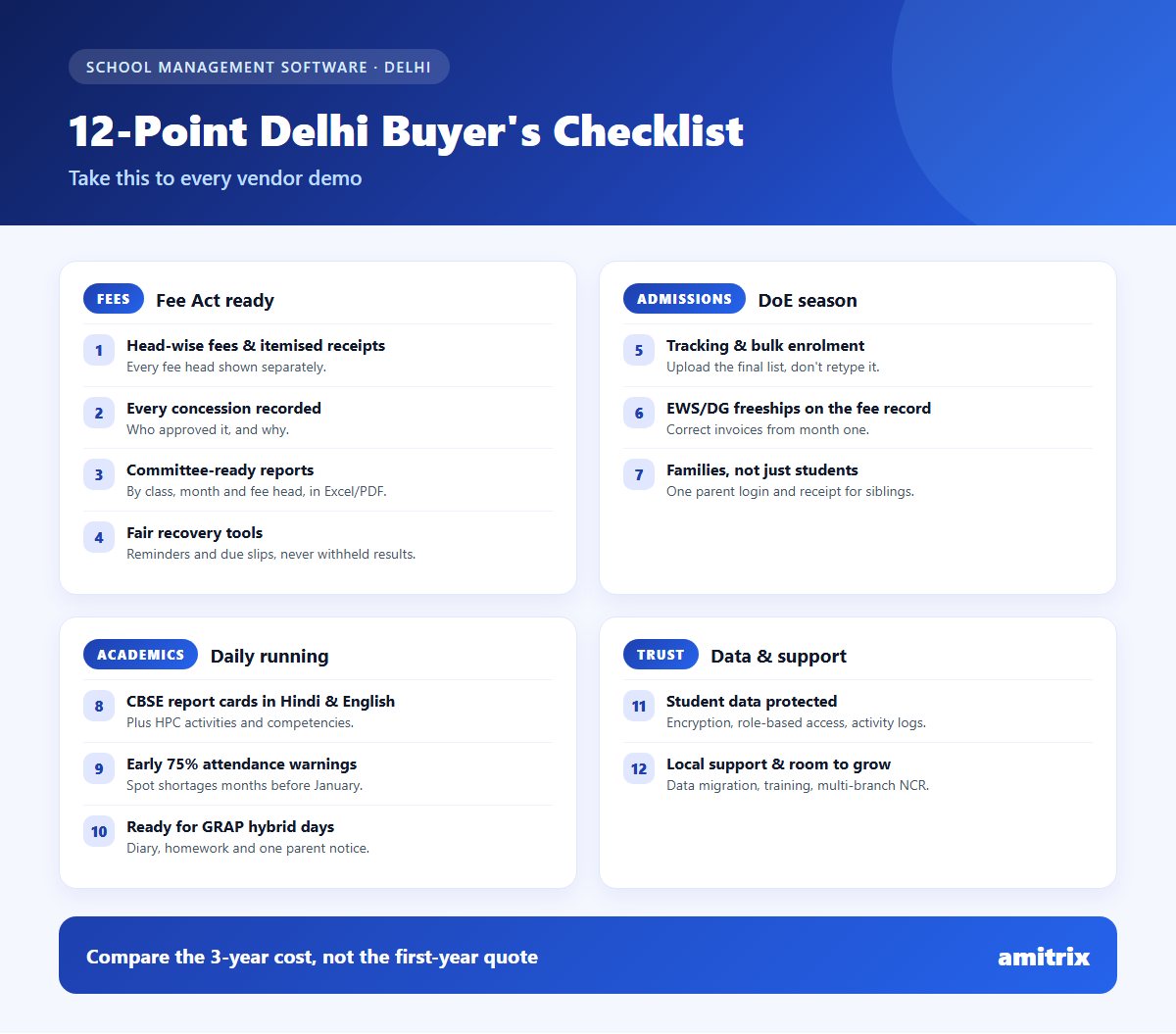
The 12-Point Delhi Checklist
Fees and compliance
1. Head-wise fee structures and itemised receipts. Every fee head (tuition, transport, activities, examinations) should be set up separately and shown separately on every invoice and receipt. A fee committee will want to see exactly what was charged under each head. Our Delhi Fee Regulation Act checklist explains why this now matters.
2. A record of every concession. When the management approves a discount, the system should record who approved it and why. A verbal concession with no record is very hard to defend in front of a parent committee.
3. Reports your committee and accountant can use. Collected, outstanding and overdue amounts by class, section, month and fee head, downloadable as Excel or PDF.
4. Fair recovery tools. Delhi's fee rules bar schools from withholding results or denying class entry over unpaid fees. The software should help you recover dues properly, with reminders, due slips and late-fee rules applied the same way to everyone.
Admissions
5. Admission tracking and bulk enrolment. Track each application through enquiry, documents and admission, then upload the final admitted list in one go instead of retyping every child. See our guide to running nursery admissions for 2027-28.
6. Freeship and EWS/DG seats handled correctly. Children admitted on free or concessional seats should carry that concession on their fee record from the first month, so their invoices are right without manual corrections.
7. Families, not just students. Siblings sharing a parent should sit under one parent login, with fees for the whole family collected in one payment and one receipt.
Academics and daily running
8. CBSE report cards in English and Hindi. Check that the system prints CBSE-format report cards in both languages, and records the activities and competencies that the Holistic Progress Card asks for.
9. Attendance that warns you early. Per-student attendance percentages, automatic absence alerts to parents, and a clear list of students heading below the CBSE 75% attendance rule well before January.
10. Ready for GRAP hybrid days. When primary classes go hybrid overnight, you need a digital diary, homework tracking and one official announcement that reaches every parent. See our GRAP hybrid classes plan.
Data, support and growth
11. Student data protection. Sensitive data such as Aadhaar and bank details should be encrypted, every role should see only what it needs, and changes should be logged. These are the safeguards the DPDP Act for schools expects.
12. Local support and room to grow. Ask who helps you move your existing data, who trains your staff, and whether the system can run several branches if your trust opens another campus in the NCR.
We will walk through all 12 points with your own classes and fee heads.
Book a free demo →What School Management Software Really Costs in Delhi
Pricing is where most schools get surprised. Vendors in India use four broad models, and the cheapest-looking quote is often not the cheapest over three years.
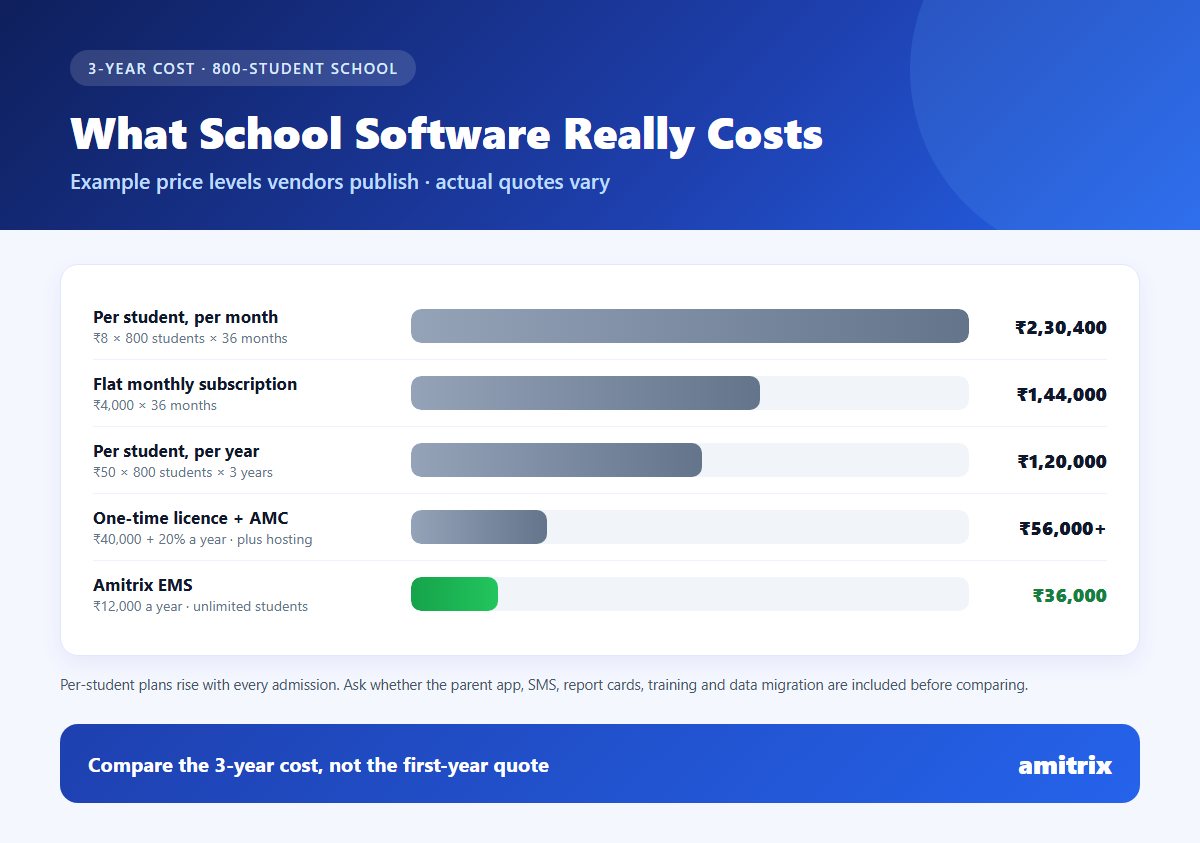
Here is how the models compare for a typical Delhi school with 800 students, using price levels that vendors publish openly. Actual quotes vary, so use this as a way to compare, not as any specific vendor's price.
| Pricing model | Example price | Cost in year 1 | Cost over 3 years |
|---|---|---|---|
| Per student, per month | ₹8 per student per month | ₹76,800 | ₹2,30,400 |
| Per student, per year | ₹50 per student per year | ₹40,000 | ₹1,20,000 |
| Flat monthly subscription | ₹4,000 per month | ₹48,000 | ₹1,44,000 |
| One-time licence + yearly maintenance | ₹40,000 + 20% AMC | ₹40,000 | ₹56,000 + hosting |
| Amitrix EMS (flat yearly, unlimited students) | ₹12,000 per year | ₹12,000 | ₹36,000 |
Three things to notice:
- Per-student pricing grows with every admission. A school that adds 200 students pays more each year for the same software.
- A low headline price can exclude essentials. Ask whether the parent app, SMS, report cards, training and data migration are included or charged separately.
- One-time licences shift costs elsewhere. You usually pay yearly maintenance and host the system yourself, which means servers, backups and someone to look after them.
For a detailed breakdown of hidden charges, read school ERP pricing in India.
10 Questions to Ask in Every Demo
Use these to cut through a polished presentation:
- Show me an itemised fee receipt and where a concession's approver is recorded.
- How would I prepare the reports our fee committee will ask for?
- Can I upload our final nursery admission list from Excel?
- How do EWS/DG freeship students appear on the fee records?
- Can you print a CBSE report card in Hindi right now?
- Which of our Class 10 students are below 75% attendance today?
- If a GRAP order arrives tonight, how do I tell every parent and post tomorrow's work?
- Which fields are encrypted, and can a teacher see fee data?
- What does year two cost if we admit 150 more students?
- Who moves our existing data, and is that included in the price?
A good vendor answers each one on screen, with your kind of data, in a few minutes.
Red Flags When Choosing Software in Delhi
- "We'll customise it for the Fee Act later." If it can't show head-wise fees and concession records today, it won't be ready for your committee.
- A demo account that is always the same. Ask to see your own classes and fee heads.
- No published price. If the vendor won't share a price until after three calls, expect the quote to grow.
- Per-student pricing with no cap. Your bill rises with every admission season.
- Support only by ticket. During admission and fee season you need a person who answers.
How Amitrix Fits Delhi Schools
Amitrix EMS is school management software built in Delhi for Delhi schools. It covers the full checklist above:
- Fees: head-wise fee structures, itemised receipts, concessions with the approver recorded, late-fee rules and Excel/PDF reports by class, section and month
- Admissions: admission status tracking, bulk upload of the final list, one parent login for siblings, and freeships on the fee record from day one
- Academics: CBSE report cards in English and Hindi, plus ICSE and State board formats
- Daily running: attendance with absence alerts, a digital diary with homework tracking, and announcements to every parent
- Data protection: encrypted sensitive fields, role-based access and activity logs
- Price: one flat ₹12,000 a year for unlimited students, with every module included
See your own school's fee heads and classes in the system before you decide. The full price list is on the pricing page.
Book a free Amitrix demo →Frequently Asked Questions
What is the best school management software in Delhi?
The best school management software for a Delhi school is one that handles the city's specific requirements: head-wise fees and concession records for the 2025 fee law, DoE entry-level admissions, CBSE report cards in Hindi and English, attendance alerts for the 75% rule, and quick switching to hybrid classes under GRAP. Use the 12-point checklist above to compare vendors.
How much does school management software cost in Delhi?
Prices vary by model. Per-student plans typically cost from a few rupees to over ₹100 per student per month, flat subscriptions run to a few thousand rupees a month, and one-time licences add yearly maintenance. Amitrix EMS charges one flat ₹12,000 a year for unlimited students.
What is the difference between school ERP and school management software?
The terms are used for the same kind of product. Both describe one system that runs admissions, attendance, fees, exams, staff and parent communication. "ERP" is more common among larger institutions and vendors; "school management software" is the phrase most school owners search for.
Does school management software help with the Delhi Fee Regulation Act?
It helps with the record-keeping the Act depends on: head-wise fee structures, itemised receipts, concession records and reports for the fee committee. The school remains responsible for the committee process, audited accounts and legal compliance.
Can school management software handle Delhi nursery admissions?
Software helps with tracking applications, collecting documents and enrolling admitted children in bulk. The admission schedule, points system and lists still follow the DoE's rules, and the school's published criteria decide who gets a seat.
Is cloud school software safe for student data in Delhi?
It can be, if the vendor encrypts sensitive data such as Aadhaar and bank details, restricts access by role, keeps activity logs and stores each school's data separately. Ask each vendor to explain these safeguards in writing.
Conclusion
The best school management software in Delhi is the one that fits the Delhi school year: DoE admissions, a fee committee that reads every receipt, CBSE report cards in two languages, the 75% attendance rule and the next GRAP order. Feature lists alone won't tell you that.
Take the 12-point checklist and the ten demo questions to every vendor, compare the three-year cost rather than the first-year quote, and choose the system that answers on screen with your own data.
Want to see how your school would run on Amitrix? Book your free demo today.