
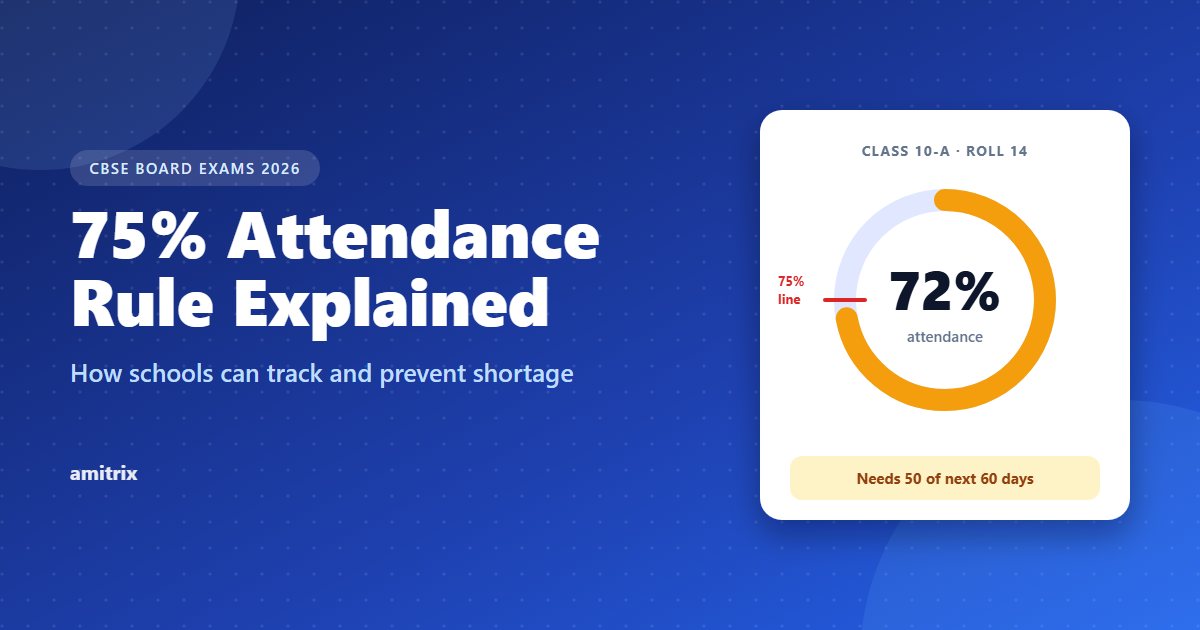
The CBSE 75% attendance rule is no longer something schools can deal with at the last minute. CBSE has made it clear that students in Classes 10 and 12 need at least 75% attendance to sit the board examinations, and it expects schools to monitor and report attendance properly.
For a student, falling short can mean missing the board exam for the year. For a school, it means difficult conversations with parents, documentation under pressure in January, and questions about how carefully records were kept.
The good news is that nearly every attendance shortage can be seen coming months in advance. This guide explains how the rule works, how to calculate attendance correctly, who can get relaxation, and a simple month-by-month system schools can use to keep every student on track.
Note: This article summarises CBSE's attendance requirements as published for the 2025–26 examination cycle. Dates and procedures can change, so always confirm details against the latest official CBSE circular.
What Is the CBSE 75% Attendance Rule?
Under the CBSE Examination Bye-Laws, a student must have attended at least 75% of the working days of the academic session to be eligible for the Class 10 or Class 12 board examination.
Key points of the rule:
- Who it applies to: regular students appearing for the Class 10 and Class 12 board exams.
- How it is counted: attendance is calculated on the school's actual working days, up to 1 January of the examination year.
- Who reports it: the school must identify students with a shortage and submit their cases, with documents, to the CBSE regional office in early January.
- What happens if it is not met: unless CBSE condones the shortage, the student may not be allowed to appear in the board exam.
CBSE has also reminded schools that students who do not attend school regularly are not considered "regular" candidates. This is part of the board's push against dummy admissions, where students are enrolled on paper but attend coaching classes instead.
Who Can Get Relaxation?
CBSE allows the shortage to be condoned in genuine cases, if they are properly documented. Commonly accepted reasons include:
- Prolonged illness or hospitalisation, supported by medical certificates
- Death of a parent or a similarly serious family situation
- Participation in sports at recognised levels (students representing at the required level have a lower minimum of 60%)
- NCC or NSS camps and other officially authorised activities
A few things schools should keep in mind:
- Relaxation is not automatic. The Head of School recommends the case, and the final decision rests with CBSE.
- Below 60%, only exceptional cases are considered, generally serious medical situations.
- Documents must be genuine and dated at the time of absence. Certificates created months later to justify old absences are unlikely to be accepted. A Calcutta High Court ruling has stressed the same point.
- A written request from the parent and the school's recommendation in the board's format are usually needed.
The simplest lesson: the relaxation process is a safety net, not a plan. A school's goal should be to keep students above 75% in the first place.
How to Calculate Attendance Percentage
The formula is simple:
Attendance % = (Days present ÷ Total working days) × 100
Only working days count. Sundays, declared holidays and school week-offs are not included in the total. This is where many manual registers go wrong: a holiday wrongly counted as a working day makes every student's percentage look worse.
Example: A Full Session
Suppose a school has 220 working days in the session.
| Attendance required | Days the student must attend | Days the student can miss |
|---|---|---|
| 75% | 165 | 55 |
| 60% (sports category) | 132 | 88 |
Example: A Student at Risk in October
The numbers become more useful during the year. Imagine it is the start of October:
- Working days held so far: 100
- Days the student was present: 70
- Current attendance: 70% — already below the line
- Working days remaining until 1 January: 60
To reach 75% by 1 January, the student needs 75% of 160 days, which is 120 days present. They already have 70, so they need 50 of the remaining 60 days.
That is still possible, but only if the school and parents act now. The same student in December would have almost no way back.
Formula for days still needed: Days needed = (0.75 × total working days up to 1 January) − days already present
Why Attendance Shortages Catch Schools by Surprise
When a shortage is discovered in December, it is rarely because nobody took attendance. It is usually one of these:
- Attendance is recorded but not reviewed. Registers are filled in daily, but nobody adds up percentages until the end of term.
- Holidays and week-offs are counted wrongly, so the percentages are inaccurate.
- Parents are informed too late. A parent told in December that their child is at 68% has very few options left.
- Records are corrected after the fact. Changing old attendance entries weakens the school's position if a case is ever questioned.
- No one owns the list. Class teachers, the office and the principal each assume someone else is watching.
Each of these is a process problem, and each can be solved with a simple routine plus the right tools.
A Month-by-Month Plan to Prevent Attendance Shortage
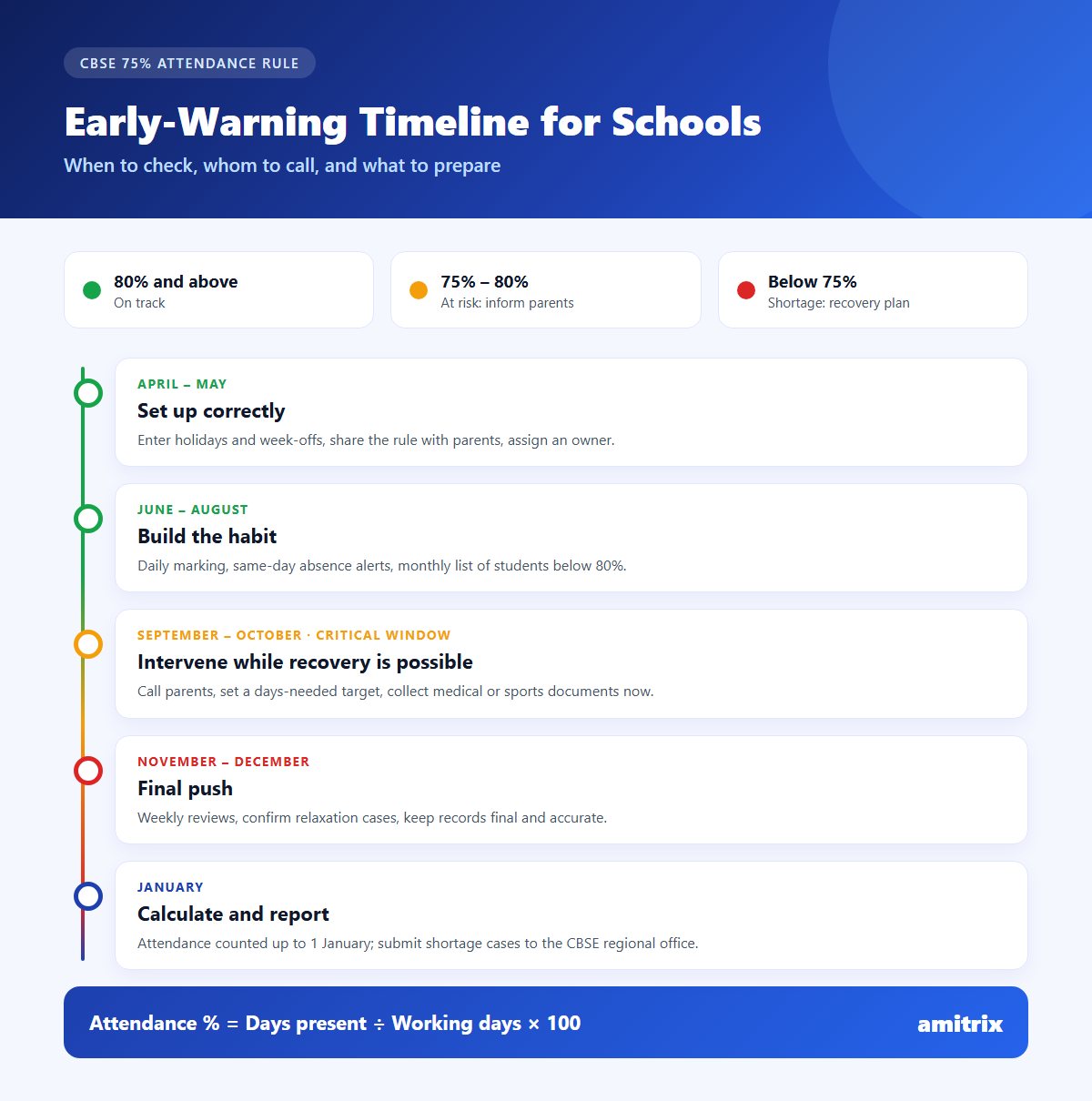
Use a three-level warning system that every staff member understands:
- 🟢 Green (80% and above): on track, no action needed
- 🟠 Amber (75–80%): at risk; inform the parent and watch weekly
- 🔴 Red (below 75%): shortage; meet the parent and start a recovery plan
April–May: Set Up Correctly
- Enter the academic calendar, holidays and week-offs before the first day, so percentages are right from the start.
- Share the 75% rule with parents in writing at the start of Classes 9–12.
- Decide who owns attendance follow-up: usually the class teacher, with the principal reviewing monthly.
June–August: Build the Habit
- Mark attendance daily and alert parents on the same day when a student is absent.
- Run a monthly report of every student below 80%.
- Look for patterns such as repeated Monday absences, or students absent for several days at a time.
September–October: The Critical Window
This is when intervention works best. There are still enough working days left to recover.
- Call parents of every amber and red student.
- Calculate the days still needed for each red student and share that number with the family. A specific target ("attend 50 of the next 60 days") works far better than a general warning.
- Start collecting supporting documents for any student with a genuine medical or sports reason. Collect them now, while they are current.
November–December: Final Push
- Review the list weekly, not monthly.
- Confirm which students will need relaxation and check that their documents are complete.
- Make sure attendance records are final and accurate. Avoid changing old entries without a clear, recorded reason.
January: Report
- Calculate attendance as of 1 January.
- Prepare shortage cases with parent requests, certificates and the school's recommendation.
- Submit to the CBSE regional office within the deadline stated in the current circular.
Find out who in your school is below 75% today, in a free 30-minute demo.
See your at-risk students →What Parents Should Know
Parents are often the missing link. Share these points with families at the start of the year:
- Attendance below 75% can stop your child from taking the board exam.
- Only genuine, documented reasons are considered for relaxation.
- Keep medical certificates at the time of illness, not months later.
- Check your child's attendance regularly. Don't wait for the school to call.
- Coaching classes are not a valid reason for missing school.
How School Software Makes the 75% Rule Easy to Manage
Doing all of this in paper registers and spreadsheets is possible, but it takes a lot of time and is easy to get wrong. A good student attendance management system does most of the work for you:
| Task | Manual register | Attendance software |
|---|---|---|
| Calculating percentages | Adding up by hand each month | Updated automatically every day |
| Excluding holidays and week-offs | Easy to miss | Taken from the school calendar |
| Informing parents of absence | Phone calls, if time allows | Automatic same-day alerts |
| Finding students below 75% | Checking every register | One filtered list |
| Spotting patterns | Rarely done | Monthly calendar view per student |
| Protecting old records | Pages can be changed | Edit limits and a record of changes |
For a full breakdown of what to look for in a school ERP, see our guide to the best school management software in India.
How Amitrix Helps Schools Stay Above 75%
Amitrix is a school management platform built for Indian schools. Its attendance features are designed for exactly this problem:
- Quick daily marking by class teachers, section by section
- Automatic percentages based on the school's real working days, with holidays and week-offs excluded
- A monthly attendance calendar for every student, showing present, absent, holiday and weekend days at a glance
- Daily absence alerts so parents know the same day
- At-risk student lists that bring low-attendance students to the principal's attention early
- A parent portal where families can check their child's attendance at any time
- Edit locks that limit how far back teachers can change attendance, protecting the integrity of your records
See how many students in your school are at risk today.
Book a free Amitrix demo →Frequently Asked Questions
What is the minimum attendance required for the CBSE board exam?
Students need at least 75% attendance, calculated on the school's working days up to 1 January of the examination year, to be eligible for the CBSE Class 10 and Class 12 board exams.
Can a student with less than 75% attendance appear in the CBSE board exam?
Only if CBSE condones the shortage. This is considered for genuine, documented reasons such as serious illness, the death of a parent, or participation in recognised sports or NCC/NSS activities. The school must submit the case to CBSE with supporting documents.
What is the minimum attendance for sports students in CBSE?
Students participating in recognised sports events have a lower minimum attendance requirement of 60%, subject to proper documentation from the relevant authority.
How do I calculate my child's attendance percentage?
Divide the number of days your child was present by the total number of working days, then multiply by 100. Holidays, Sundays and school week-offs are not counted as working days.
Are holidays counted in CBSE attendance?
No. Only the school's working days are counted. Declared holidays and week-offs are excluded from the total.
What documents are needed for an attendance shortage case?
Typically, a written request from the parent, valid certificates (such as medical certificates dated at the time of illness), and the school's recommendation in CBSE's prescribed format. Check the latest CBSE circular for the exact requirements.
Conclusion
The CBSE 75% attendance rule only becomes a crisis when schools discover a shortage too late. With the right calendar set-up, monthly reviews, early parent communication and properly kept records, almost every at-risk student can be brought back above the line.
Start with the September–October window. It is the point where a clear target and a phone call to parents can still change the outcome.
Want to see every at-risk student in your school in one click? Book your free Amitrix demo today.