
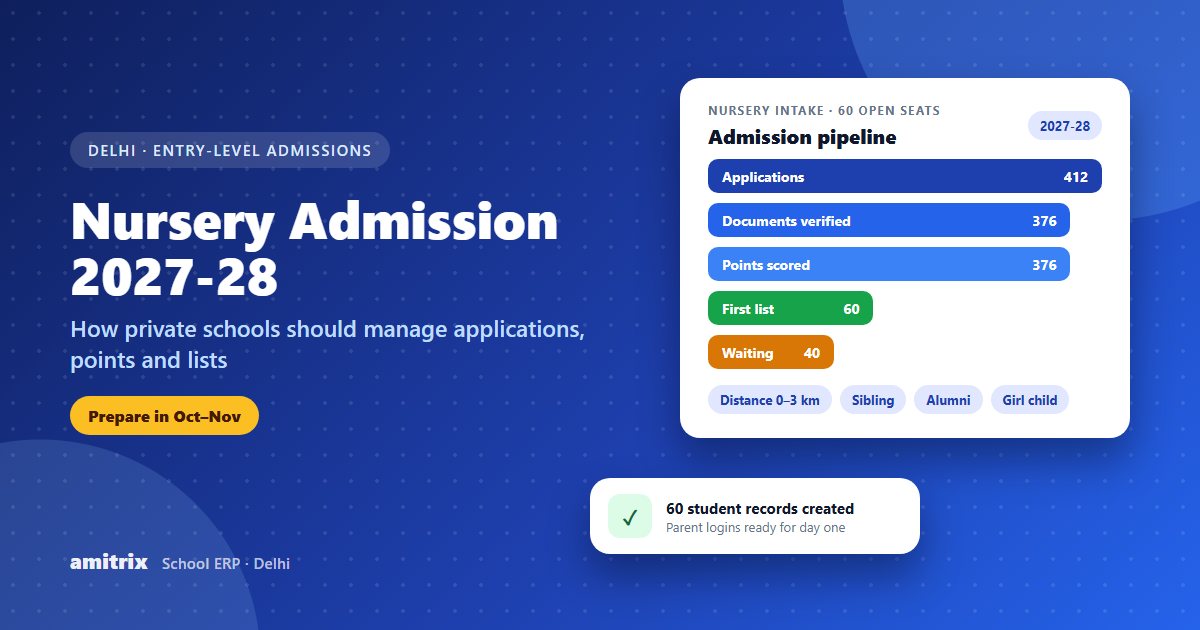
Every winter, Delhi's private schools go through the same pressure test. Within a few weeks, a school with 60 nursery seats may receive several hundred applications, each needing to be checked, scored and placed on a list, and every decision has to stand up to a parent's question.
Most guides to Delhi nursery admission 2027-28 are written for parents. This one is written for the other side of the counter: the principal, the admission in-charge and the office team who have to run the process fairly, on time and without disputes.
Important: At the time of writing, the Directorate of Education (DoE) has not yet announced the official 2027-28 schedule. Everything below is based on the previous cycle and the established framework. The DoE usually publishes the schedule in November. Check edudel.nic.in and update your plan when it is released. We will update this guide as well.
How Delhi Nursery Admissions Work: The Short Version
Delhi's entry-level admissions (Nursery, KG and Class 1) in private unaided recognised schools follow a process set by the DoE:
- The DoE announces the schedule for the whole city.
- Each school publishes its own admission criteria and points, within the DoE's rules.
- Parents apply to as many schools as they choose during the registration window.
- Schools score applications using their published points and upload the results.
- Lists are displayed, first list, waiting list and further lists, followed by a window for parents' queries.
- Admissions close on the date set by the DoE.
Alongside this, 25% of entry-level seats are reserved for children from Economically Weaker Sections (EWS), Disadvantaged Groups (DG) and Children with Special Needs (CWSN). Those seats are allotted centrally by the DoE through a computerised draw, not through your school's points system.
The Timeline to Plan Around
Here is how the previous cycle (2026-27) ran, which gives you a realistic template for 2027-28:
| Step | Previous cycle (2026-27) | What your team should do |
|---|---|---|
| Schedule announced | Late November | Read the order the day it is published |
| Criteria uploaded by schools | Before registration opens | Finalise and publish your points table |
| Registration window | 4 to 27 December | Receive and check every application |
| Applicant details uploaded | 9 January | Upload the full list of applicants |
| Points uploaded | 16 January | Upload each child's score |
| First list (with waiting list) | 23 January | Publish on notice board and website |
| Parents' queries | 24 January to 3 February | Answer every query in writing |
| Second list | 9 February | Publish if seats remain |
| Further lists | Early March | Fill remaining seats |
| Admissions close | 19 March | Close and reconcile |
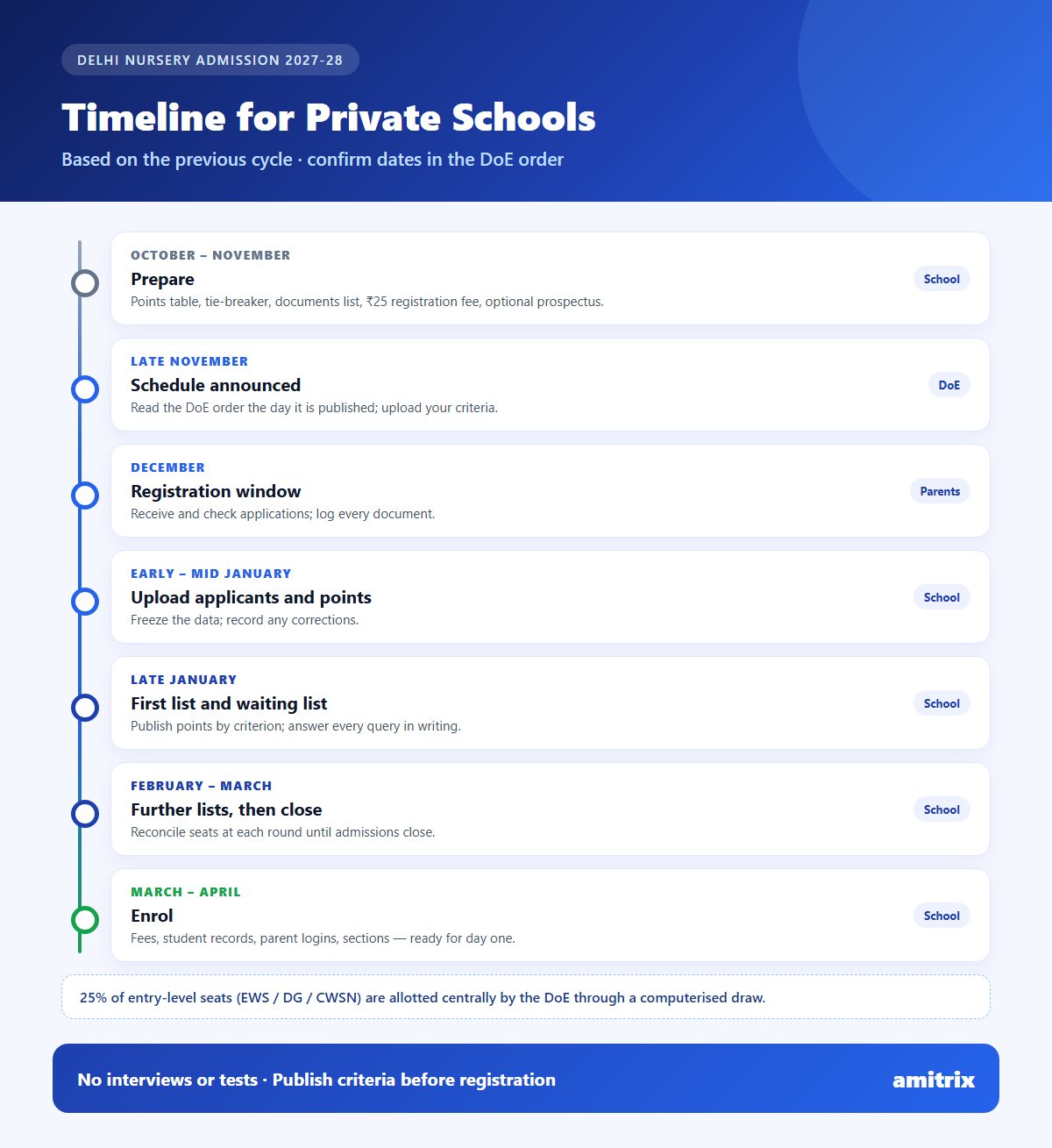
Plan your preparation for October and November, before the schedule is announced. Once registration opens, there is no time to fix forms, criteria or systems.
Age Criteria
In the previous cycle, the age limits as on 31 March of the admission year were:
| Class | Age as on 31 March |
|---|---|
| Nursery | 3 to under 4 years |
| KG | 4 to under 5 years |
| Class 1 | 5 to under 6 years |
Confirm the age limits and any relaxation rules in the current DoE order before rejecting a borderline application, and record the reason for any rejection on age grounds.
Designing Your Points Criteria
Your points table is the heart of the process and the most common source of disputes. Each school sets its own, but the criteria must be published in advance, objective and applied exactly as published.
Criteria schools commonly use
| Criterion | How schools typically score it |
|---|---|
| Neighbourhood / distance | Usually the highest weight, in distance bands (for example, 0–3 km highest, then lower bands) |
| Sibling studying in the school | Fixed points |
| Alumni parent | Fixed points |
| Girl child | Fixed points |
| First child | Fixed points |
| Single parent | Fixed points |
| Staff ward | Fixed points, where permitted |
Rules of thumb for a dispute-proof table
- Every point must be verifiable from a document. If you award points for distance, define exactly how distance is measured and which address proof you accept.
- Avoid vague criteria. Anything that depends on judgement, such as "overall suitability", invites challenges.
- No interviews or tests. Entry-level admissions do not permit interviewing or testing the child or parents.
- Publish the tie-breaker. Decide in advance how you will separate equal scores, usually by a draw of lots, and say so in your criteria.
- Check the DoE's list of disallowed criteria in the current order before publishing yours.
Fees You May Charge During Admission
Keep this simple and within the rules:
- The registration fee is limited to ₹25 and is non-refundable.
- Buying the prospectus must be optional, not a condition of applying.
- Under the Delhi School Fee Regulation Act 2025, the admission charge is capped at ₹200 and caution money at ₹500, refundable.
Check your online form and printed prospectus now. An old fee printed on a form is one of the easiest things for a parent to challenge.
Documents to Collect and Verify
Decide in advance exactly which documents you accept for each criterion, and list them in your published criteria:
| Purpose | Common documents |
|---|---|
| Child's age | Birth certificate |
| Address and distance | Aadhaar, passport, voter ID, electricity or water bill, registered rent agreement, property tax receipt |
| Sibling | Sibling's admission or ID details from your own records |
| Alumni | Parent's school-leaving or pass certificate |
| Other categories | Relevant certificate as per your criteria |
| Child's records | Photograph, immunisation record |
The more you can verify from your own records, such as sibling details, the fewer documents parents need to upload and the fewer mistakes your team makes.
Managing Lists Without Disputes
The first list is where trust is won or lost. A few practices make a large difference:
- Publish scores, not just names. A list showing each applicant's points by criterion lets parents check their own score and reduces queries.
- Publish the waiting list in order. Parents who can see their position are far less likely to file complaints.
- Answer every query in writing. Log the query, the date and your response. If a decision is challenged later, this record protects the school.
- Freeze the data before scoring. Once registration closes, stop editing applications except to correct proven errors, and record every correction.
- Reconcile seats at each list. Track exactly how many seats are filled, pending and vacant after each round, so later lists are accurate.
After Selection: Turning Applicants into Students
Once a family accepts a seat, the work shifts from admissions to enrolment:
- Collect fees against the approved fee structure, with an itemised receipt.
- Create the student record with parent contact details, so the child is ready for attendance and communication from day one.
- Give parents access to the school's portal or app before the session starts.
- Collect remaining documents such as immunisation records, and track what is still pending.
- Assign the child to a section and confirm it with the parents.
This stage is where a manual process usually breaks. The same details get typed again into the fee register, the attendance register and the class list. Brothers and sisters can sit under one parent login, so a family pays for all its children in one payment with one receipt.
See how Amitrix turns your final admission list into class-ready student records in one upload.
Book a free demo →A Pre-Season Checklist for Your Admissions Team
Complete these in October and November:
- Review last year's queries and complaints and fix their causes
- Finalise your points table and tie-breaker rule
- Check every fee on your form against the ₹25 registration cap
- Make the prospectus optional
- Decide exactly which documents you accept for each criterion
- Assign one person to own the query register
- Prepare list templates with points by criterion
- Brief your front office on what they can and cannot say to parents
- Prepare your system to create student records from the final list
How Amitrix Helps with Admissions
Amitrix EMS does not run the DoE's process or calculate your points. Your published criteria and the DoE portal stay at the centre of the admission itself. Where Amitrix helps is everything around it, and especially the part after selection:
- Bulk student registration from Excel: upload your final admitted list in one go, with a row-by-row report of anything that needs fixing
- Parent logins created automatically for each child's guardian, so families have access before the session starts
- Student document checklist: you choose which documents are required, and parents or staff upload them for the office to approve or reject with a reason
- Admission and enrolment status for each student
- Siblings under one parent login, with fees for the whole family taken in one payment
- Fee collection from day one, with itemised receipts based on your fee structure
- Class and section assignment, ready for attendance on the first day
See how your nursery intake moves from list to classroom. You can also read about our school ERP for Delhi.
Book a free Amitrix demo →Official Sources to Check
The admission schedule, age limits and rules on criteria are set by the DoE every year. Treat its order as the final word:
- Directorate of Education, Delhi: the entry-level admission schedule, guidelines and orders for private unaided recognised schools
More Delhi guides from Amitrix: the Delhi School Fee Regulation Act 2025 checklist and switching to hybrid classes under GRAP, since admission season and pollution orders often overlap.
Frequently Asked Questions
When will Delhi nursery admission 2027-28 start?
The DoE has not yet announced the 2027-28 schedule. In the previous cycle, the schedule was announced in late November and registrations ran through December, with the first list in late January.
What is the age limit for nursery admission in Delhi?
In the previous cycle, children had to be 3 to under 4 years old as on 31 March of the admission year for nursery. Check the DoE's current order for 2027-28.
What is the maximum registration fee for nursery admission in Delhi?
The registration fee is limited to ₹25 and is non-refundable. Buying the school prospectus must be optional.
Can private schools in Delhi interview children for nursery admission?
No. Entry-level admissions do not permit interviewing or testing children or their parents.
How are EWS and DG seats filled in Delhi private schools?
25% of entry-level seats are reserved for EWS, DG and CWSN children. These seats are allotted centrally by the DoE through a computerised draw, not through the school's own points system.
How should a school decide between two applicants with equal points?
The tie-breaking method, usually a draw of lots, should be decided and published in the school's admission criteria before registration opens.
Conclusion
Running Delhi nursery admission 2027-28 well comes down to preparation and records. A clear, published points table, documents defined in advance, lists that show scores, and a written answer to every query will prevent most disputes before they start.
Use October and November to get ready, read the DoE order the day it is published, and make sure the moment a child is admitted, their record is ready for the classroom.
Want a smoother path from admission list to first day? Book your free Amitrix demo today.