
For years, a fee hike in a Delhi private school was decided in the management office and announced in a circular. Parents could complain, but there was no fixed process for checking whether the increase was justified.
The Delhi School Fee Regulation Act 2025 changes that. Officially titled the Delhi School Education (Transparency in Fixation and Regulation of Fees) Act, 2025, it gives parents a formal role in approving fees, caps several one-time charges, and makes schools prove their numbers with audited accounts. The Delhi government has said it applies from the 2026-27 academic session.
This guide is written for the people who have to make it work inside a school: owners, principals, administrators and accountants. It explains what the law requires in plain language, then gives you a checklist you can work through with your team.
Disclaimer: This article is general information, not legal advice. It is based on the Act and on published reports of its Rules. Some operational details, such as committee composition and exact deadlines, are described differently in different reports. Always confirm against the official notification and Directorate of Education (DoE) orders, and consult a legal professional for your school's situation.
The Act at a Glance
| Point | What it means for your school |
|---|---|
| Who it covers | Private unaided recognised schools in Delhi |
| When it applies | From the 2026-27 academic session |
| Who approves fees | A School Level Fee Regulation Committee that includes parents |
| How long fees stay fixed | Three academic years once approved |
| Appeals | District-level appeal committee, then a Revision Committee as the final authority |
| Proof required | Audited financial statements and fee-wise records |
| Penalties | ₹1–5 lakh for a first violation, ₹2–10 lakh for repeat violations, plus refunds |
What Has Actually Changed
Before this law, schools largely set fees themselves and disputes went to the DoE or the courts after the fact. The new framework moves the scrutiny before the fee is charged:
- Parents sit at the table. Fees must be reviewed by a committee that includes parents, rather than decided by management alone.
- Fees are locked for three years. Once approved, a fee structure stays in place for three academic years, giving families predictability.
- Numbers must be justified. Tuition fee is meant to cover operational and academic costs. Capital expenditure, such as new buildings, is not supposed to be recovered through tuition fee.
- Unapproved charges are not allowed. Any amount that is not expressly permitted under the Act or its Rules is treated as an unjustified fee demand.
- Refunds are enforced. Excess fees must be returned, and delays make the penalty grow.
The Three Committees
The Act sets up a three-level system. Think of it as review, appeal and final decision.
1. School Level Fee Regulation Committee (SLFRC)
This is the committee your school will deal with every year. Published reports describe it as including:
- A representative of the school management
- Teachers
- Parents, selected by a draw of lots
- An observer nominated by the Directorate of Education
Reports also state that the committee should include women and members from Scheduled Castes, Scheduled Tribes and backward classes. The number of teachers and parents is reported differently in different sources, so check the notified Rules for the exact composition.
The most important rule to understand: the committee can approve or reduce the fee your school proposes, but it cannot increase it. If you under-propose, you cannot recover the difference later in the same cycle.
2. District Fee Appellate Committee
If parents disagree with what the school-level committee approved, they can appeal at the district level. Reports describe a group of parents representing at least 15% of enrolled students as able to appeal within 30 days.
3. Revision Committee
A higher-level Revision Committee acts as the final authority on fee disputes.
Charges That Are Now Capped
Several charges that used to vary widely between schools are now capped:
| Charge | Maximum |
|---|---|
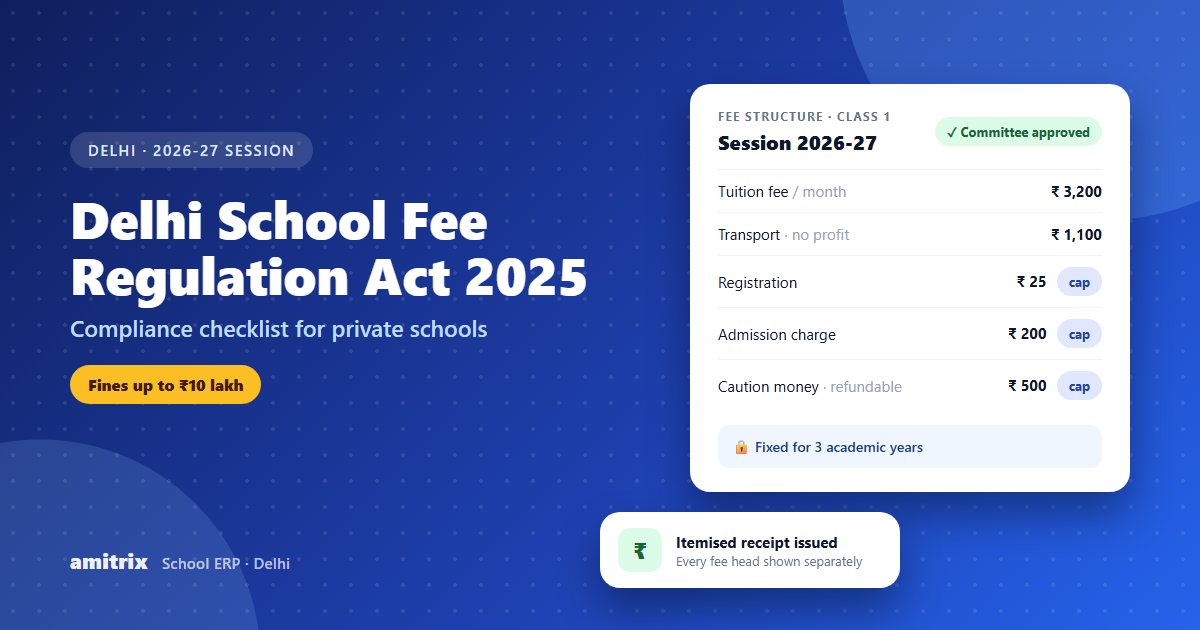
| Registration fee | ₹25 |
| Admission charge | ₹200 |
| Caution money | ₹500, refundable |
If your prospectus, admission form or fee portal still shows higher amounts, change them before your next admission cycle. Nursery admissions are usually the first place parents notice. The registration fee for Delhi's entry-level admissions has also been set at ₹25. See our guide to running nursery admissions for 2027-28.
What Schools Must Not Do
The Act and its Rules make several common practices off-limits:
- Charging capitation fees, whether openly or disguised as a "donation" or "development contribution".
- Collecting any charge that was not approved through the fee process.
- Withholding a child's result or denying entry to class because of unpaid fees.
- Transferring money collected from students to other entities, such as the managing trust's other ventures.
- Making a profit on user-based charges such as transport. These should be collected on a no-profit, no-loss basis.
Unpaid fees are still a real problem for schools, and the law does not ask you to ignore them. It does mean recovery has to happen through reminders, documented follow-up and the proper process, not by holding a child's report card or keeping them out of class.
Records Your School Must Be Ready to Show
The new framework depends on documents. Reports on the Rules describe schools needing:
| Record | What to keep |
|---|---|
| Audited financial statements | Three years, certified by a Chartered Accountant registered with ICAI |
| Financial statements | Balance sheet, income and expenditure account, cash flow statement |
| Cash book | Day-to-day receipts and payments |
| Fee register | Every invoice and receipt, by student and fee head |
| Salary records | Staff salaries, a major justification for tuition fee |
| Assets register | Separates capital spending from running costs |
| Vouchers | Supporting evidence for expenses |
| Head-wise fee breakup | Published, so parents can see what each fee head covers |
Parents are also reported to have the right to receive financial documents within seven days of asking, digitally free of charge or as hard copies at a nominal per-page cost.
The practical point: if your fee records live in three different registers and a spreadsheet, preparing for the committee becomes a scramble every year. One clean, head-wise fee record makes every other step easier.
Penalties and Refunds
| Situation | Consequence |
|---|---|
| First violation | Fine of ₹1 lakh to ₹5 lakh |
| Repeat violation | Fine of ₹2 lakh to ₹10 lakh |
| Excess fee charged | Must be refunded within 20 working days |
| Refund delayed | Penalty grows: doubled after 20 days, tripled after 40 days, and so on |
Reports also mention that repeated non-compliance can lead to wider action against the school's recognition. For most schools the bigger cost is not the fine. It is the loss of parents' trust that follows a public fee dispute.
The Compliance Checklist
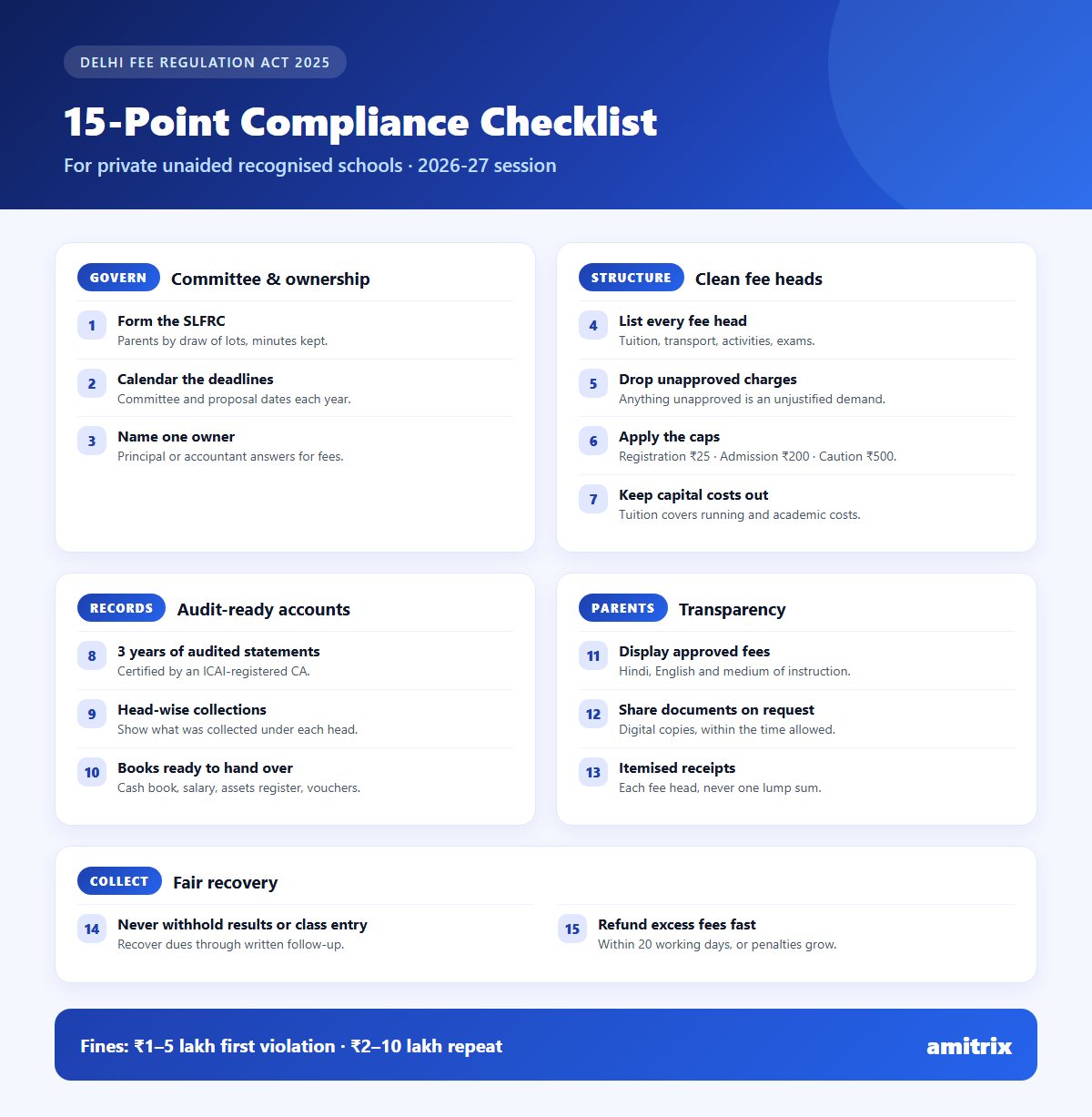
Work through these with your management, principal and accountant. Tick each item only when someone can show the evidence.
Governance
- Form your SLFRC as directed by the DoE, including the parent draw of lots, and keep the minutes of how members were chosen.
- Calendar the yearly deadlines for forming the committee and submitting your fee proposal. Reports describe these falling in July each year. Confirm the dates for your school in the current DoE order.
- Name one person responsible for fee compliance, usually the principal or school accountant.
Fee structure
- List every fee head your school charges, including transport, activities and examination fees.
- Remove anything that cannot be justified or that has not been approved.
- Bring registration, admission and caution money within the caps.
- Separate capital costs from running costs in your proposal, since tuition fee should not fund new construction.
Accounts and records
- Get three years of audited statements ready, certified by an ICAI-registered Chartered Accountant.
- Keep fee collections head-wise, so you can show exactly what was collected under each approved head.
- Maintain the cash book, salary records, assets register and vouchers in a form you can hand over quickly.
Parents
- Display the approved fee structure on the notice board in Hindi, English and the medium of instruction, and on your website.
- Set up a way to share financial documents with parents within the required time, ideally digitally.
- Issue itemised receipts, so parents see each fee head, not one lump sum.
Collection practices
- Stop withholding results or class entry for unpaid fees, and put written recovery steps in place instead.
- Track refunds of any excess fee against the 20-working-day limit.
See how Amitrix keeps every fee head, receipt and concession in one audit-ready record.
Book a free demo →Common Mistakes Schools Are Making
- Leaving old caps in printed material. A prospectus showing a ₹1,000 registration fee is evidence against you.
- Bundling charges. A single "annual charge" with no breakup is difficult to justify to a committee.
- Verbal concessions. A discount promised in the office, with no record of who approved it, looks like an unexplained fee difference later.
- Spreadsheets edited by many people. If nobody can tell who changed a figure, the figure is hard to defend.
- Waiting for the deadline. Audited accounts take weeks. Start before the committee meets, not after.
How Fee Software Makes Compliance Easier
None of these obligations require software. But almost all of them become simpler when fees are managed in one system rather than registers and spreadsheets.
| Obligation | Manual approach | With fee management software |
|---|---|---|
| Head-wise fee records | Separate registers per head | Every invoice split by fee head automatically |
| Itemised receipts | Handwritten or typed | Generated for every payment, with each head shown |
| Proof of concessions | Notes in a file, if any | Each concession recorded with who approved it and why |
| Reports for the committee | Compiled by hand | Collection and outstanding reports by class, month and head |
| Answering parents' questions | Searching through files | Parents see their own invoices and receipts online |
For a broader view of what to look for in a system, see our guide to the best school management software in India. If you are comparing costs, our article on school ERP pricing in India explains what vendors usually leave out of the quote.
How Amitrix Helps Delhi Schools
Amitrix EMS is built in Delhi for Indian schools. Its fee management is designed around exactly the transparency this law is asking for:
- Fee structures by class, with separate fee heads such as tuition, transport and activities
- Invoices generated only from the structure you set up, so no unapproved charge slips in
- Itemised receipts showing each fee head and how much of each was paid
- Concessions with a full record: who approved them, at what level, and the reason
- Late fees with grace periods and caps, configurable to match whatever your approved structure allows
- Collection, outstanding and defaulter reports you can download as Excel or PDF for your accountant and committee
- A parent portal where families see their own invoices, dues and receipts
Amitrix keeps your fee records clean and ready to show. Your audited accounts, committee process and legal compliance remain your school's responsibility, and your Chartered Accountant still prepares the financial statements.
See how your fee structure looks in a system built for audits. Amitrix costs one flat ₹12,000 a year for unlimited students. See the pricing page, or read more about our school ERP for Delhi.
Book a free Amitrix demo →Official Sources to Check
The Act, its Rules and every fee-related order are published by the Government of NCT of Delhi. Before acting on any deadline or committee rule, read the current version at the source:
- Directorate of Education, Delhi: circulars and orders on fee committees, timelines and fee structures for private schools
More Delhi guides from Amitrix: nursery admissions for 2027-28 and switching to hybrid classes under GRAP.
Frequently Asked Questions
Which schools does the Delhi School Fee Regulation Act 2025 apply to?
It applies to private unaided recognised schools in Delhi. Government and government-aided schools follow separate rules.
From when does the Delhi fee regulation law apply?
The Delhi government has said the law applies from the 2026-27 academic session. Schools should follow the DoE's orders for the first cycle of fee committee formation and approval.
Can a Delhi private school increase fees every year?
Not freely. Under the Act, the fee approved through the committee process stays fixed for three academic years, and any proposal has to be justified with financial records.
What is the maximum registration fee for a Delhi private school?
The registration fee is capped at ₹25. Admission charges are capped at ₹200 and caution money at ₹500, which must be refundable.
Can a school withhold a student's result for unpaid fees in Delhi?
No. The Rules bar schools from withholding results or denying a child entry to class because of unpaid fees. Schools must recover dues through proper follow-up instead.
What is the penalty for violating the Delhi fee regulation law?
Reported penalties are ₹1 lakh to ₹5 lakh for a first violation and ₹2 lakh to ₹10 lakh for repeat violations. Excess fees must be refunded within 20 working days, and delays increase the penalty.
Conclusion
The Delhi School Fee Regulation Act 2025 rewards schools that keep their fee records clean and their charges transparent. The schools that will struggle are those relying on bundled charges, verbal concessions and records spread across registers.
Start with the checklist above: form your committee, list and clean up your fee heads, bring capped charges into line, and get your audited accounts ready early. Then make sure every receipt your school issues would stand up to a parent's question.
Want fee records that are ready for any committee? Book your free Amitrix demo today.