
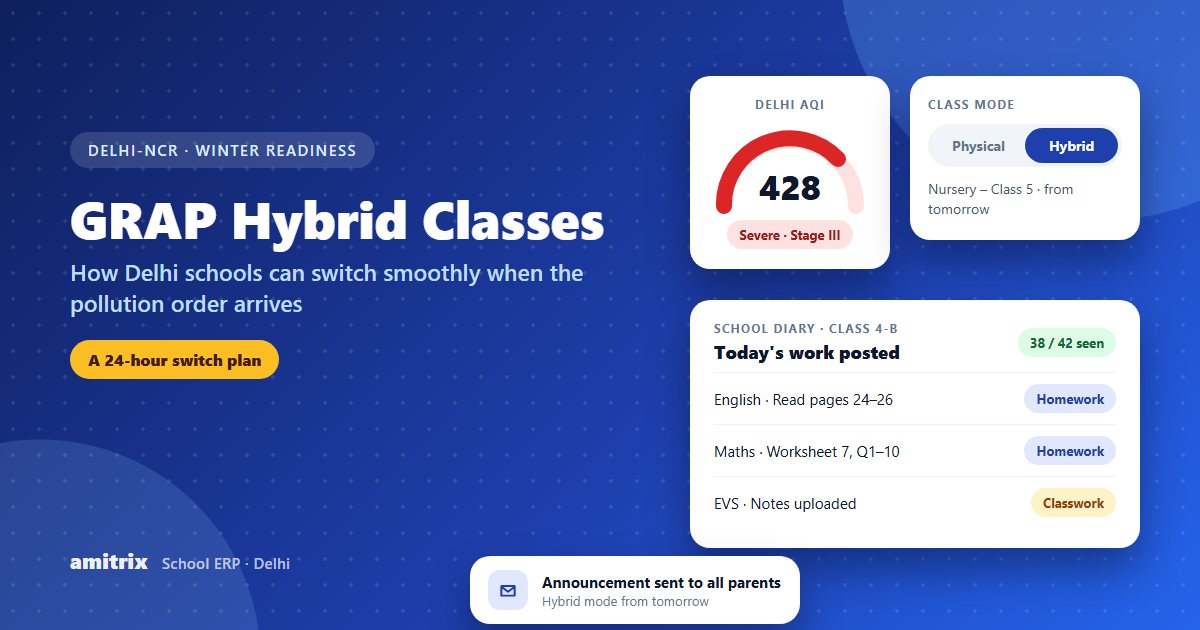
It usually happens late in the evening. The air quality worsens, the Commission for Air Quality Management (CAQM) moves Delhi-NCR to a higher stage of the Graded Response Action Plan (GRAP), and the Directorate of Education (DoE) issues an order. By the next morning, schools are expected to run GRAP hybrid classes: some children in the room, others learning from home.
Over the last two winters, Delhi schools have switched between physical and hybrid classes several times, sometimes for a few days, sometimes for weeks. The schools that coped best were not the ones with the most technology. They were the ones that had planned for it.
This guide explains what GRAP means for schools and which classes are affected at each stage, then gives you a practical plan to switch to hybrid classes smoothly, before the next order arrives.
Note: GRAP rules and DoE orders can change from season to season. The details below reflect the revised GRAP schedule and orders issued in recent winters. Always follow the latest CAQM and DoE orders for your school.
What Is GRAP?
GRAP is a set of emergency measures that come into force in stages as air quality worsens in Delhi-NCR. Each stage adds restrictions, on construction, vehicles and industry, and at the higher stages, on schools.
| GRAP stage | Air quality (AQI) | What it means |
|---|---|---|
| Stage I | Poor (201–300) | Basic dust and pollution controls |
| Stage II | Very Poor (301–400) | Tighter controls |
| Stage III | Severe (401–450) | Wider restrictions, primary classes go hybrid |
| Stage IV | Severe+ (above 450) | Strictest measures, most classes go hybrid |
Which Classes Go Hybrid at Each Stage
Under the revised GRAP schedule:
| Stage | Classes in hybrid mode | Classes that usually continue physically |
|---|---|---|
| Stage III | Up to Class 5 | Class 6 and above |
| Stage IV | Up to Class 9, and Class 11 | Classes 10 and 12 |
Classes 10 and 12 have generally continued in person because of board examinations.
What "hybrid" means: schools run classes both in person and online wherever online learning is feasible, and students and parents can choose the online option where it is available. Your school does not close. It runs two modes at once, which is exactly why it is harder than a simple closure.
Who it applies to: DoE orders have covered government, government-aided and recognised private schools, along with schools under the NDMC, MCD and Delhi Cantonment Board. Schools in Gurugram, Faridabad, Ghaziabad and Gautam Buddh Nagar follow their own district orders under the same GRAP schedule.
Why Hybrid Is Harder Than It Sounds
During a full closure, everyone is at home and the plan is simple. Hybrid mode creates a split classroom:
- Some children are in class and some are at home, often changing day to day.
- Teachers must serve both groups in the same period.
- Attendance becomes unclear: is a child at home absent, or attending online?
- Parents need instructions within hours, often late at night.
- Homework and notes must reach children who were not in the room.
- The order can be withdrawn just as suddenly, so you may switch back within days.
The goal is not perfect online teaching. It is that no child loses track of their work and every parent knows what is happening.
Before the Season: Prepare in October
Do this work while the air is still breathable:
1. Decide your hybrid model
Choose one approach and write it down. For example: teachers teach the physical class as usual, and the same day's classwork and homework is posted for children at home by a fixed time, with an optional live session for core subjects.
2. Define how attendance will be recorded
Decide exactly how you will mark a child who chooses online learning. Be consistent across all classes. For Classes 10 and 12, attendance has board consequences, so read our guide to the CBSE 75% attendance rule and check the board's current guidance before treating any day differently.
3. Confirm parent contacts
Every switch depends on reaching parents quickly. Check now that every child has at least one working guardian phone number.
4. Prepare message templates
Write the announcements in advance, in English and Hindi:
- "Classes up to Class 5 will run in hybrid mode from tomorrow."
- "You may choose online learning for your child. Here is how to access today's work."
- "Physical classes will resume from [date]."
5. Train teachers on one routine
One routine, used by every teacher, is far better than each teacher improvising. Agree on where classwork, homework and notes will be posted, and by what time.
6. Identify children without devices
Some families will not have a laptop or smartphone free during school hours. Know who they are in advance, so you can offer printed work or keep the in-person option clearly open for them.
The 24-Hour Switch Plan
When the order arrives, work through these steps in order.
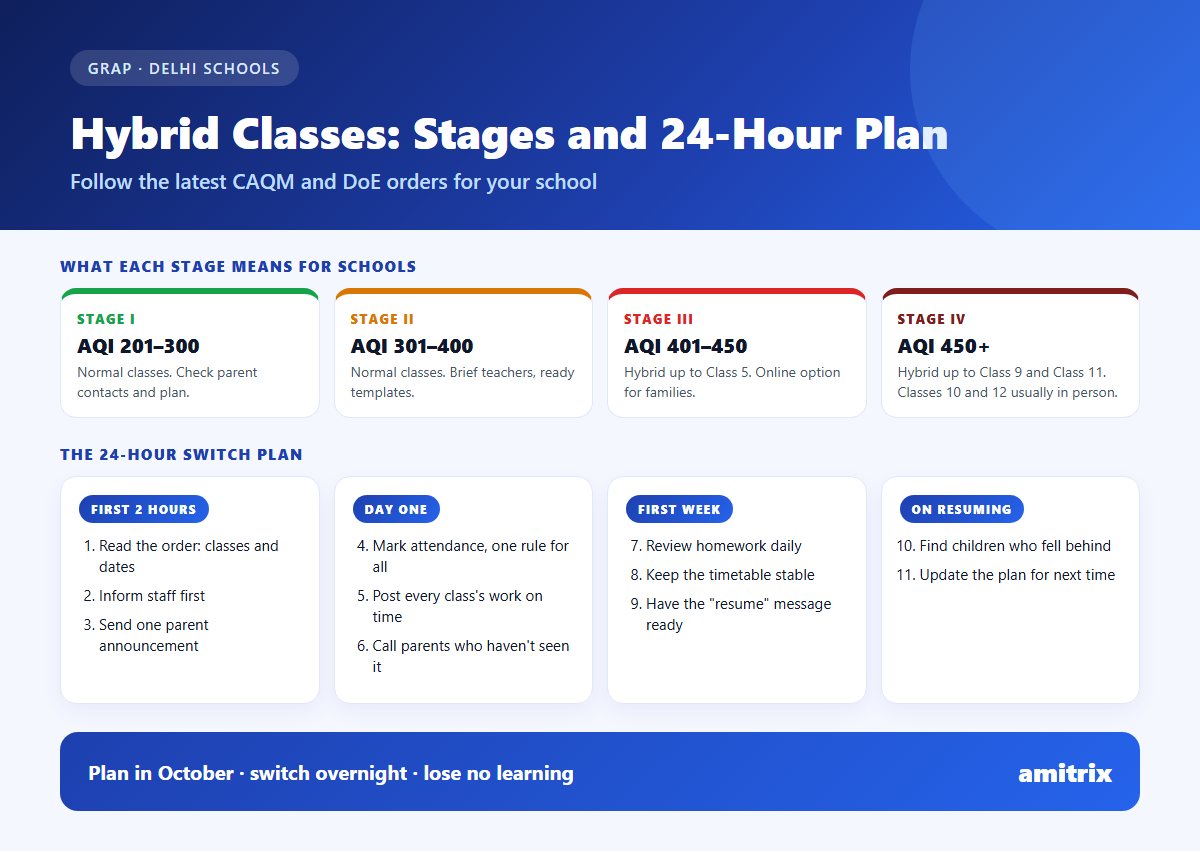
Evening the order arrives (first 2 hours)
- Read the order carefully and confirm exactly which classes and dates it covers.
- Inform staff: class teachers and subject teachers need to know before parents do.
- Send the parent announcement using your prepared template, with clear instructions for the next morning.
Next morning (first school day)
- Mark attendance using your agreed approach for in-person and online students.
- Post every class's work (classwork, homework and any notes) by the agreed time.
- Check which parents have not seen the announcement and follow up by phone.
First week
- Review homework completion daily so children working from home do not quietly fall behind.
- Keep the timetable stable. Changing periods as well as mode confuses everyone.
- Watch for the withdrawal order. Have the "resume physical classes" message ready.
When physical classes resume
- Identify children who fell behind during the hybrid period and plan catch-up support.
- Note what went wrong and update your plan for the next switch.
See how Amitrix gets the day's homework to every child at home within minutes of the order.
Book a free demo →Communication: The Part Most Schools Get Wrong
When parents complain about hybrid classes, it is rarely about teaching quality. It is about confusion. To prevent it:
- Send one official message per decision, from one channel, rather than several teachers posting different versions in different groups.
- Say what is changing, from when, for which classes, and what parents need to do.
- Confirm receipt. Know which parents have actually seen the message, and call the rest.
- Keep teacher–parent questions in one place, linked to the specific homework or class, so nothing gets lost in a crowded group chat.
Keeping Learning on Track
Hybrid periods are short but can come back several times in one winter. To keep children on track:
- Post work every day, even if there is no live session.
- Track homework done and not done for each child, so teachers can see who is falling behind at home.
- Share study materials that children can use without a live teacher.
- Keep Classes 10 and 12 focused. They usually stay in school, but their teachers may also be covering hybrid classes, so protect board-exam preparation time.
Common Mistakes to Avoid
- No plan until the order arrives. The first 12 hours are the hardest, so plan before the season.
- Different rules in different classes. Parents with two children notice immediately.
- Losing track of attendance. Unclear records cause problems later, especially for board classes.
- Relying only on chat groups. Messages get buried, and you cannot tell who has read them.
- Forgetting children without devices. Hybrid mode should never mean a child loses access to learning.
Winter is also when Delhi schools prepare for nursery admissions. Our guide to running nursery admissions for 2027-28 covers that season.
How Amitrix Helps Schools During GRAP
Amitrix EMS does not run video classes, and you can keep using whatever video tool your teachers already know. What it does is make sure the rest of the school keeps working when classrooms split:
- Digital school diary: each day's classwork and homework, by subject, visible to every parent and student
- "Seen" confirmation: parents mark the day's diary as seen, so you know who has received the update
- Homework review: teachers record who completed homework and who did not, for children in class and at home
- Teacher–parent messages linked to each homework, instead of questions lost in group chats
- Quick daily attendance with automatic absence alerts to parents
- Announcements to reach every family with one official message
- Study materials that students can open from home
See how your school can switch to hybrid mode without losing a day. You can also read about our school ERP for Delhi.
Book a free Amitrix demo →Official Sources to Check
GRAP stages are declared by the Commission for Air Quality Management, and school orders follow from the DoE. Check both whenever air quality worsens:
- Commission for Air Quality Management (CAQM): the GRAP schedule and orders on which stage is in force
- Directorate of Education, Delhi: orders telling schools which classes move to hybrid mode, and when physical classes resume
More Delhi guides from Amitrix: the Delhi School Fee Regulation Act 2025 checklist and nursery admissions for 2027-28.
Frequently Asked Questions
What is GRAP and how does it affect Delhi schools?
GRAP (Graded Response Action Plan) is a set of emergency measures for Delhi-NCR that come into force in stages as air quality worsens. At Stage III and Stage IV, schools are directed to shift certain classes to hybrid mode.
Which classes go hybrid under GRAP Stage III?
Under the revised GRAP schedule, classes up to Class 5 shift to hybrid mode at Stage III, with students and parents able to choose online learning where it is available.
Which classes go hybrid under GRAP Stage IV?
At Stage IV, classes up to Class 9 and Class 11 shift to hybrid mode. Classes 10 and 12 have generally continued in person.
Does hybrid mode mean schools are closed?
No. Hybrid mode means schools run classes both in person and online wherever online learning is feasible, and families can choose the online option where available.
Do GRAP school orders apply to private schools in Delhi?
Yes. DoE orders have applied to government, government-aided and recognised private schools, as well as schools under the NDMC, MCD and Delhi Cantonment Board.
How should schools record attendance during hybrid classes?
Schools should decide and apply one consistent approach for in-person and online students across all classes. For Classes 10 and 12, check the board's current guidance, since attendance affects exam eligibility.
Conclusion
GRAP hybrid classes are now a regular part of winter in Delhi. Schools that treat each order as a surprise lose days of learning and a great deal of parents' goodwill. Schools that plan in October switch overnight with little disruption.
Decide your hybrid model, prepare your messages and attendance approach, confirm parent contacts, and make sure every child's daily work can reach them at home. Then, when the next order arrives, your team will only have to follow the plan.
Ready for the next GRAP order? Book your free Amitrix demo today.