
For most of the last fifty years, an Indian report card has been a single sheet of marks. Subject, maximum, obtained, grade, a line of remarks at the bottom that usually read "Good. Can do better." Parents looked at the percentage, compared it with a cousin's, and filed it away.
The Holistic Progress Card (HPC) is a deliberate break from that. Designed by PARAKH, the national assessment centre under NCERT, and grounded in NEP 2020, it asks schools to describe how a child is growing — not just how they scored in a written paper. That is a good idea. It is also, for a school that still runs on registers and spreadsheets, a genuinely large amount of new work.
This guide is about that second part. Not the philosophy of the HPC, which is well covered elsewhere, but what it actually demands of a school day to day, where the effort goes, and how to organise things so the card writes itself at term end instead of consuming the last two weeks of it.
What makes the HPC different from a marks sheet
A traditional report card records an outcome. The HPC records a process. It is built on four ideas that each change what a teacher has to collect.
It is competency-based. Instead of "Mathematics: 72/100", the card describes what a child can do — reads a simple bar graph, estimates a quantity, explains a pattern in their own words — and how securely they can do it. A score is one piece of evidence, not the whole verdict.
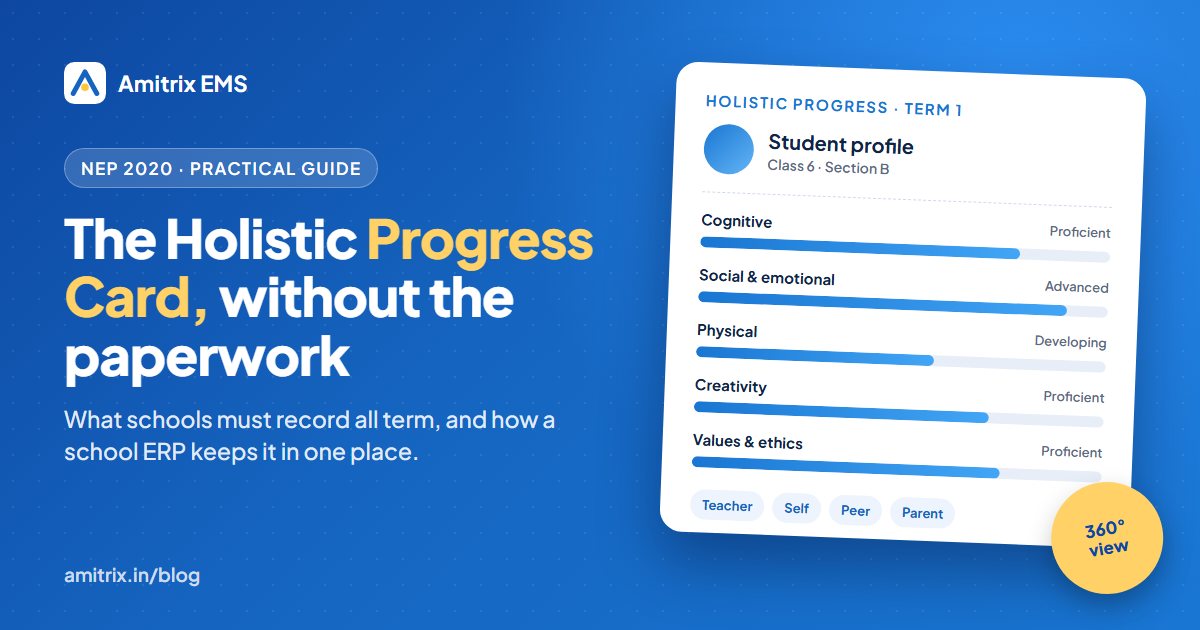
It looks at the whole child. Alongside cognitive learning, the card covers social and emotional growth, physical development, creativity, and values. A child who struggles with long division but leads every group activity should be visible as exactly that.
It hears more than one voice. This is the part schools underestimate. The HPC is designed as 360-degree feedback: the teacher's assessment sits beside the student's own self-reflection, observations from peers, and input from parents. Four sources, not one.
It is continuous. The card summarises a term, but it has to be built from what happened during the term — activities, projects, observations, conversations. You cannot reconstruct three months of classroom observation from memory the week before results.
PARAKH has published separate HPC formats for the foundational, preparatory and middle stages, with the secondary stage following, because what "progress" looks like for a six-year-old is not what it looks like for a fourteen-year-old. The foundational card leans on observation and play; the middle-stage card moves towards projects, self-assessment, and subject competencies.
Where the real workload is
Walk through what a class teacher with 40 students needs for one HPC cycle, and the problem becomes obvious.
For every student, the teacher needs dated observations across several domains, records of the activities and projects the child took part in, the child's own reflections, some form of peer input, whatever parents shared at the parent–teacher meeting, attendance across the term, and the usual test performance — all mapped against competencies rather than chapters.
Multiply that by 40 and by every subject teacher who contributes, and the issue is not whether teachers are willing. It is that this information is scattered:
- attendance sits in one register
- marks sit in a spreadsheet the exam coordinator maintains
- co-curricular participation lives with the sports and activities teachers
- parent concerns are in someone's WhatsApp chats and a PTM notebook
- discipline and health notes are in two more files, in two more offices
- the child's own reflections, if collected at all, are loose sheets in a folder
At term end, somebody has to pull all of it together for every child. That is the point at which schools either produce a thin HPC with generic remarks — which defeats the purpose — or ask teachers to spend nights assembling evidence by hand.
The HPC does not fail for lack of good intent. It fails because the evidence it needs was never captured in one place while it was happening.
Organise evidence around the child, not the department
The single most useful change a school can make is structural. Stop filing evidence by who recorded it and start filing it by which student it is about.
When every observation, activity, attendance mark, test result, health visit, and parent conversation attaches to the student's profile at the moment it is recorded, the term-end HPC stops being a research project. The class teacher opens one child's record and the whole term is already there, in date order.
A few practical habits make this work:
Capture small and often. A two-line observation recorded on the day ("explained her group's solution clearly; hesitant when asked to estimate") is worth more than a paragraph written from memory in March. Short, dated notes are also far easier for a teacher to fit into a real school day.
Tag by domain as you go. If a note is tagged cognitive, social-emotional, physical or creative when it is written, sorting it later takes seconds. If it is not, somebody has to reread everything.
Make participation automatic. When a student is added to a sports team, a science fair, a house event or a competition, that record should land on the student's profile without anyone copying it across. The activities in-charge should not be a separate source the class teacher has to chase.
Give parents a real channel. The HPC expects parent input. A written note in a diary, a message about homework, or a recorded PTM outcome is exactly that input — if it is captured somewhere a teacher can find it again, instead of disappearing into a phone.
Let the data flag who needs attention. Continuous records make patterns visible early: an attendance dip, a string of missed homework, a sudden fall in test performance. Catching those in week six is the entire point of continuous assessment. Catching them on the report card is too late to help.
A week-by-week rhythm for each term
Schools that handle continuous assessment well tend to settle into a simple rhythm rather than a heroic term-end push.
Weeks 1–2: set the frame. Decide which competencies each class will focus on this term and share them with teachers. Agree on a small, common set of observation tags so everyone records things the same way.
Every week: record, briefly. Teachers add a handful of short observations per class. Attendance and homework completion are recorded daily as part of normal work, not as a separate HPC task.
Mid-term: first student voice. Students complete a simple self-reflection — what they found easy, what they found hard, what they would like to get better at. For younger children this can be as simple as choosing a picture or a face.
PTM: capture the parent view. Record what the parent says at the meeting and any follow-up agreed. This is some of the richest evidence the HPC can contain, and it is usually the first thing lost.
Last two weeks: review, don't reconstruct. The class teacher reviews each child's collected evidence, adds a considered narrative, and reconciles it with test performance. Because the material already exists, this is judgement work rather than clerical work — which is what teachers should be spending time on.
Common mistakes to avoid
Turning descriptors into disguised marks. Swapping "80–90%" for the word "Proficient" is the same marks sheet in a new font. Competency descriptors only mean something when they are backed by observed evidence.
Copy-paste remarks. Describing thirty-eight children as "sincere and hardworking" tells a parent nothing. The HPC is meant to show each child's uniqueness; generic remarks are the clearest sign that evidence was missing.
Treating self and peer assessment as a formality. A tick-box sheet filled in five minutes before the card is printed adds nothing. Short, regular reflection is more honest and far more useful.
Ignoring language. A card that parents cannot read has failed at its most basic job. Many families are far more comfortable in Hindi, Marathi, Gujarati, Tamil, or another regional language than in English, and a progress card is the one school document every parent actually reads.
Leaving mid-year joiners to inherit the term. A student admitted in November should not carry an attendance percentage or missed-work record from months when they were not enrolled. Continuous records have to know when each child's term actually began.
What to look for in a school ERP for NEP-ready assessment
Most school ERP software in India was designed around the old marks sheet: a table of subjects, a table of scores, and a print button. That is fine for results day and not much else. If your school is choosing or replacing an ERP with the Holistic Progress Card in mind, these are the questions that separate a system that helps from one that simply digitises the old register.
- Is everything stored against the student? Attendance, marks, activities, health, discipline and parent communication should all open from one student profile — not from five modules that never talk to each other.
- Can a teacher record a short, dated observation in under a minute? If it takes longer, it will not happen on a busy school day.
- Does it capture the parent voice? Diary notes, messages and PTM outcomes should be saved and searchable, not left on a teacher's personal phone.
- Does it handle your board and your language? A CBSE school in Delhi, an ICSE school in Bengaluru and a state-board school in Pune need different report formats, and many parents read Hindi or a regional language more comfortably than English.
- Does it know when each student joined? A mid-year admission should not inherit an attendance percentage from months before enrolment.
- Does it flag concerns early? Continuous assessment only helps if falling attendance or missed homework shows up while there is still time to act.
- Is the price predictable? Per-student pricing grows every time admissions do. Ask for the total cost across three years before comparing vendors.
How Amitrix EMS supports this
Amitrix EMS is a school ERP built for Indian schools, and we built it around the student profile precisely because this is where school data belongs. The HPC format itself is set by your board; what an ERP can do is make sure the evidence behind it already exists. Much of that is captured in Amitrix EMS as part of ordinary school operations:
- Daily attendance, with a month-by-month history on each student's profile
- Examination marks and results, with competency and grading-system setup
- The student diary — homework, class notes, and two-way parent–teacher messages, all dated and tied to the student
- Activities and achievements, recorded against the students who took part
- Discipline and health records, visible to the staff who need them
- PTM bookings and outcomes, so parent conversations are not lost
- Students-needing-attention alerts, surfacing attendance and performance patterns early in the term
- CBSE report cards in English, Hindi, Gujarati, Marathi and Tamil, plus ICSE and State board formats
The effect is that by the end of term, the evidence a teacher needs is already sitting against each child — in one place, in date order, with the parent's voice included — instead of spread across a dozen registers.
Frequently asked questions
Is the Holistic Progress Card compulsory for every school? The HPC comes from NEP 2020 and has been developed by PARAKH at NCERT, and CBSE has published its own implementation guides and teacher handbooks. How and when it applies depends on your board and your state, so check the latest circular from your affiliating board rather than relying on a general article.
Does the HPC replace marks completely? No. Test performance is still part of the picture. What changes is that marks become one kind of evidence alongside observation, projects, self-reflection, peer input and the parent's view, all read against competencies.
Can a small school manage the HPC without software? Yes, with discipline — a folder per child and a weekly habit of adding notes. The difficulty is scale: once a teacher has 40 students and several contributing colleagues, paper is hard to keep complete, and that is where a school ERP earns its place.
We are a school in Delhi. Can Amitrix EMS be set up for us? Yes. Amitrix EMS works for schools anywhere in India, including Delhi NCR, and supports CBSE, ICSE and State board report cards. We migrate your existing student and fee records as part of onboarding. See how it fits the Delhi school year, from nursery admissions to the fee committee.
In short
The Holistic Progress Card is not really a new report card. It is a new way of paying attention to children through the term, with the card as the summary at the end.
Schools that treat it as a term-end form will find it exhausting and the results will look generic. Schools that capture small pieces of evidence as they happen, attached to each child, will find the card is mostly done by the time it is due — and far more honest about the child it describes.
If you would like to see how your school's records would look organised around each student, book a 30-minute demo. We will load a sample of your own data before the call. You can also read how we think about school ERP pricing in India.