
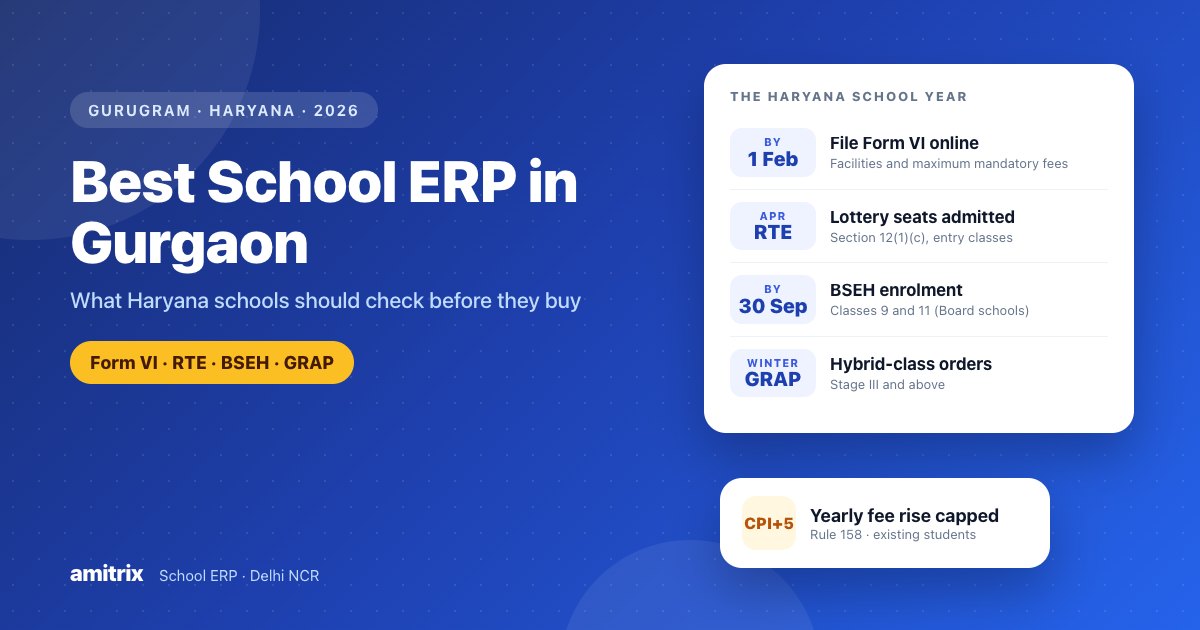
Shortlisting the best school ERP in Gurgaon looks easy on paper. Every vendor promises fees, attendance, exams and a parent app. The hard part is the Haryana rulebook that sits underneath a Gurugram school: a fee declaration due every February, a fixed list of fee heads, a cap on yearly increases, lottery-based RTE seats, Board enrolment deadlines for Classes 9 to 12, and the hybrid-class orders that arrive with winter smog.
Software built for "any school in India" usually handles none of that out of the box. This guide lists what a school in Gurugram (Gurgaon) - from Sohna Road to Sector 56 to DLF Phase 1 - should check before signing, and the questions that expose a weak system in the first demo.
Disclaimer: This is general information, not legal advice. It summarises the Haryana School Education Rules, 2003 (as amended up to December 2021), the state's RTE notifications and official GRAP releases. Rules and dates change, so confirm every requirement with the Department of School Education, Haryana and your own advisers.
Why Gurugram Schools Need a Haryana Checklist
Four things shape the year for a private school in Gurugram:
- Fees follow Rule 158. Haryana's school education rules decide which fee heads you may charge, how often you may collect them, and how much you may raise them each year.
- Free seats go by lottery. The old Rule 134A was omitted in 2022, and seats for weaker-section children now go through the state's online RTE process, with a draw of lots when applicants outnumber seats.
- Board enrolment has hard deadlines. Schools affiliated to the Board of School Education Haryana (BSEH) must enrol their Class 9 to 12 students by fixed dates.
- Gurugram is in the NCR. Air-quality orders under GRAP name the district directly, and they can move junior classes to hybrid mode at short notice.
A school ERP that ignores these four leaves your accounts office maintaining a second set of spreadsheets for the state.
Haryana Fee Rules Your Software Must Handle
Rule 158 of the Haryana School Education Rules, 2003 is the part that touches your fee module most. Here is what it says, and what to look for in the software.
Form VI, every February
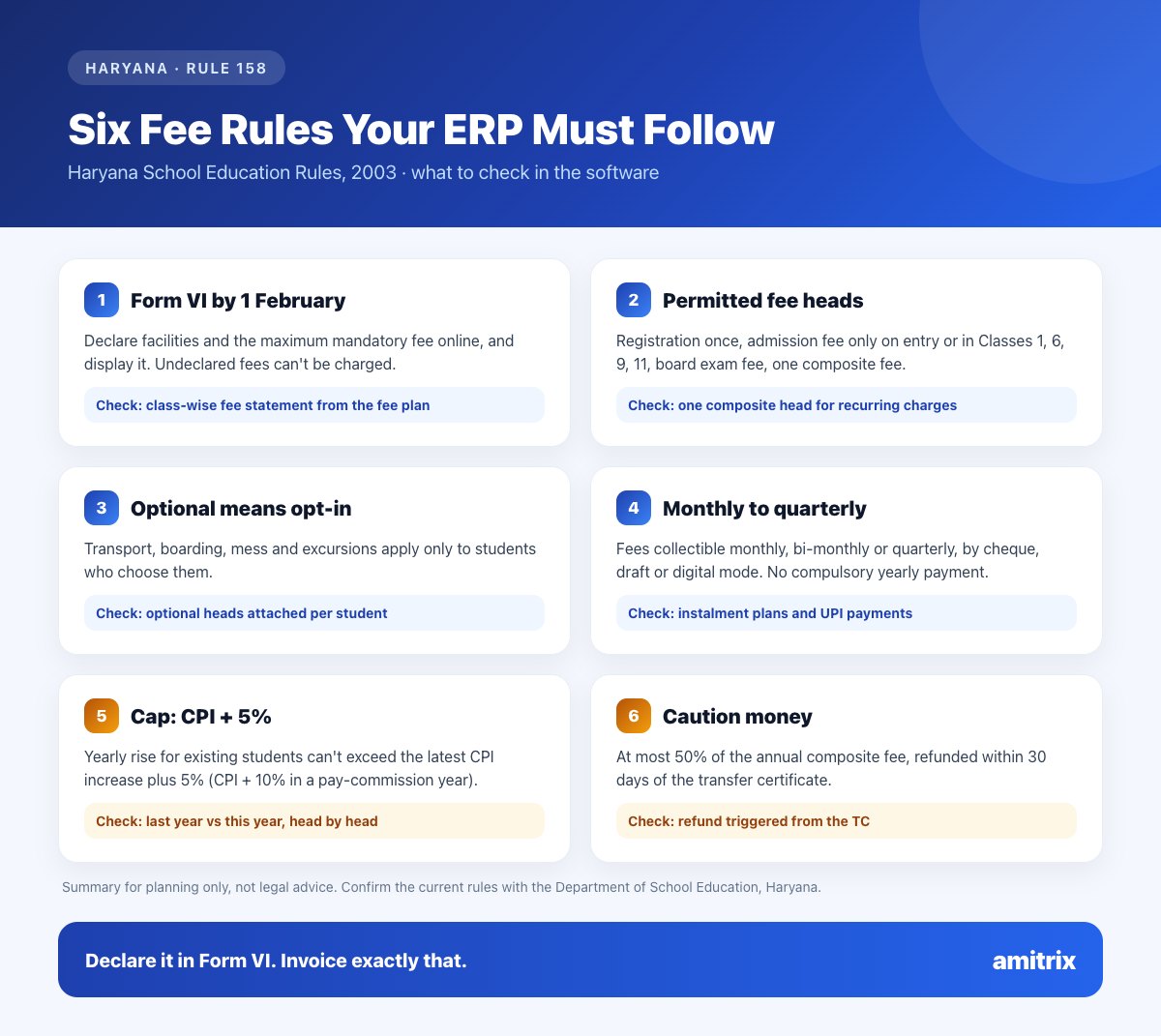
Each year a school files Form VI online with the Director by 1 February, declaring its facilities and the maximum mandatory fee for the coming session. The form has to be shown on the notice board or school website, and a mandatory fee that is missing from Form VI cannot be charged at all. If the form is not filed, the school cannot raise its fees that year.
Software check: Can the system print a class-wise statement of every mandatory fee that matches your Form VI, so that what you declare and what you invoice never drift apart?
A short list of fee heads
The Rules allow a small set of mandatory charges: a one-time registration or prospectus fee, an admission fee (charged only on new admission or in Classes 1, 6, 9 and 11), board examination fees, and a single composite fee for all recurring charges. Transport, boarding, mess and excursions are optional fees that apply only to students who choose them.
Software check: You should be able to set one composite head for recurring charges, keep optional heads attached only to the children who opted in, and stop the admission fee from appearing in classes where it isn't allowed.
How often you may collect
Fees may be collected monthly, every two months or quarterly. A school cannot make half-yearly or annual payment compulsory. Payment has to be by cheque, draft or a digital mode.
Software check: Instalment plans should be set to monthly, bi-monthly or quarterly, with online payment (including UPI) built in.
Caution money and refunds
Security deposit is capped at 50% of the annual composite fee and must be refunded within 30 days of the transfer certificate being issued.
Software check: The refund should be triggered from the TC process, with the date recorded.
The yearly increase cap
For existing students, the yearly rise can follow the average increase in teaching-staff salaries, but it cannot exceed the latest CPI increase plus 5% (CPI plus 10% in a year when a new pay commission is implemented). Fees cannot be increased in the middle of a session. Schools whose total mandatory fees are at or below ₹12,000 a year (primary) or ₹15,000 a year (higher classes) are outside the cap.
Software check: Your fee plans should keep last year's figures beside this year's, so the increase on every head is visible before a single invoice goes out.
At admission, one full statement
Parents must be handed the full fee structure for every class up to Class 12 for that year. A good system prints this straight from the fee plan you have already set.
Books, uniforms and complaints
Schools cannot force families to buy books, stationery or uniforms from a particular shop, and cannot change the uniform within five years. Complaints are heard by the division's Fee and Fund Regulatory Committee, chaired by the Divisional Commissioner, which can order refunds and impose penalties. Clean records are your best defence.
We will set up a Haryana-style fee plan - composite fee, optional transport and quarterly instalments - on your own classes.
Book a free demo →RTE Seats After Rule 134A
Haryana omitted Rule 134A in 2022. Admission of weaker-section and disadvantaged-group children under Section 12(1)(c) of the RTE Act now runs through the Directorate of Elementary Education on harprathmik.gov.in: private schools declare their seats, families apply online, and a draw of lots decides when applicants outnumber seats. For the 2026-27 session the department published district seat summaries in March and opened admissions in April.
For your software, that means:
- Seat records by entry class - Nursery, KG and Class 1, as declared
- A clear RTE flag on each admitted child, carried onto the fee record from the first month
- Reports for reimbursement claims, since the state reimburses schools for these seats at the rate it fixes
BSEH Enrolment and Student Data
If your school is affiliated to the Haryana Board, its Enrolment Branch expects every regular student in Classes 9 to 12 to be enrolled. The BSEH enrolment page sets 30 September for Classes 9 and 11 and 31 May for Classes 10 and 12 (or dates the Chairman notifies), with late fees after that.
The state also maintains a school MIS that gives each student a registration number, and private schools have been told to keep their student data up to date there.
Software check: Can you export clean student lists - name spellings, dates of birth, parents' names, Aadhaar where collected - in Excel, in one click? Re-typing 200 Class 9 records into a portal is where most errors start.
CBSE, ICSE and international-board schools in Gurugram have their own registration cycles, so look for exports you can shape to any format.
GRAP Days and School Buses in Gurgaon
GRAP orders
The Commission for Air Quality Management's GRAP schedule names Gurugram along with Delhi, Faridabad, Ghaziabad and Gautam Buddh Nagar. At Stage III, classes up to Class V move to hybrid mode, and at Stage IV more classes can follow. Official PIB releases on GRAP school measures set this out, and in recent winters the Gurugram district administration has issued its own orders for online or hybrid classes.
What helps on those mornings:
- One announcement to every parent, by app, SMS and WhatsApp
- Homework and a digital diary that keep working when children are at home
- Attendance that records hybrid days properly, so nobody is marked absent for staying online
Our GRAP hybrid classes plan is written for Delhi, but the steps apply to any NCR school.
School buses: GPS and cameras
Haryana's transport department circulated a draft Surakshit School Vahan Policy in 2024. Its inspection checklist covers vehicles owned by the school and vehicles run by contractors, and lists a working GPS tracking device, IP cameras that keep at least 15 days of recordings, a speed governor and a lady attendant when girls travel. Check the final notified version with your district transport office before you budget.
Software check: Look for a transport module that keeps vehicle and driver details on file, connects to the GPS tracker you already use, lists children by stop, and tells parents when the bus is near.
Best School ERP in Gurgaon: The 10-Point Checklist
| # | What to check | Why it matters in Haryana |
|---|---|---|
| 1 | Class-wise fee statement that matches Form VI | A fee missing from Form VI cannot be charged |
| 2 | One composite head for recurring charges | Rule 158 lists the permitted heads |
| 3 | Optional fees tied only to opted-in students | Transport and boarding are optional by rule |
| 4 | Monthly, bi-monthly or quarterly instalments | Compulsory yearly collection is not allowed |
| 5 | Year-on-year comparison of every head | The CPI-plus-5% cap applies to existing students |
| 6 | Caution money refund linked to the TC | Refund due within 30 days |
| 7 | RTE flag and reimbursement reports | Lottery seats and state reimbursement |
| 8 | Excel exports for BSEH and the state MIS | Enrolment deadlines for Classes 9 to 12 |
| 9 | Instant notices and digital diary | GRAP hybrid orders name Gurugram |
| 10 | Transport module with GPS connection | Draft bus-safety policy lists GPS and cameras |
What School ERP Costs in Gurgaon
Gurugram schools meet the same four pricing models as the rest of the NCR: per student per month, per student per year, flat monthly plans and one-time licences with maintenance. On per-student pricing, a large Gurugram campus pays more every time it adds a section. We work through the numbers for 300, 800 and 2,000-student schools in our school ERP price guide; the arithmetic is identical across the border.
How Amitrix Fits Gurugram Schools
Amitrix EMS serves schools across Delhi NCR from one cloud platform. For a Haryana school it offers:
- Fees: fee plans by class and student category, a composite head or itemised heads as you prefer, optional heads only where opted in, instalments, online payment by UPI and cards, and invoices that carry your GSTIN
- RTE: concession seats flagged and kept correct on the fee record
- Data: student lists exportable to Excel for Board and state portals, with transfer certificates generated from the record
- Daily running: attendance alerts to parents, a digital diary and announcements for GRAP days
- Transport: routes, stops, vehicle and driver records, and a connection to your GPS trackers
- Report cards: CBSE, ICSE and State board formats in English and Hindi
- Price: one flat ₹12,000 a year for unlimited students, with every module included
Our team is based in East Delhi, and demos run online, so a Gurugram school can see the system on its own data without anyone travelling. See how the platform works for the wider region on our Delhi NCR school ERP page, or check the pricing page. If your trust also runs a campus across the Yamuna, our Noida guide for UP schools covers Uttar Pradesh's rules.
See your own Form VI fee heads set up before you decide.
Book a free Amitrix demo →Frequently Asked Questions
What is the best school ERP in Gurgaon?
The best school ERP for a Gurugram school is one that handles Haryana's rules as well as daily school work: fee heads and instalments that match Rule 158 and your Form VI, RTE seat records, exports for BSEH enrolment, quick notices for GRAP days and a transport module. Use the 10-point checklist above to compare vendors.
Does Haryana limit how much private schools can raise fees?
Yes. Under Rule 158, the yearly increase for existing students cannot exceed the latest CPI increase plus 5%, or CPI plus 10% in a pay-commission year. Schools with total mandatory fees up to ₹12,000 (primary) or ₹15,000 (higher classes) a year are outside the cap.
What is Form VI for Haryana schools?
Form VI is the yearly declaration of facilities and maximum mandatory fees that a private school files online with the Director by 1 February. It must be displayed publicly, and a mandatory fee not shown in it cannot be charged.
Can a Gurugram school collect fees annually?
A school may offer annual payment, but it cannot make half-yearly or annual payment compulsory. Fees must be collectible monthly, every two months or quarterly.
Is Rule 134A still used for free seats in Haryana?
No. Rule 134A was omitted in 2022. Free seats for weaker-section and disadvantaged-group children are now filled under Section 12(1)(c) of the RTE Act through the state's online process, with a lottery when applicants exceed seats.
How much does school ERP software cost in Gurugram?
It depends on the pricing model and your enrolment. Amitrix EMS charges a flat ₹12,000 a year for unlimited students; per-student plans grow with every admission.
Conclusion
The best school ERP in Gurgaon is the one that already knows Haryana: Form VI every February, a composite fee and optional heads, instalments no longer than a quarter, the CPI-plus-5% cap, lottery-based RTE seats, BSEH enrolment and the next GRAP order. Ask each vendor to show those on screen with your own classes, and compare the three-year cost rather than the first quote.
Want to see your Haryana fee plan running in a real system? Book your free demo today.