
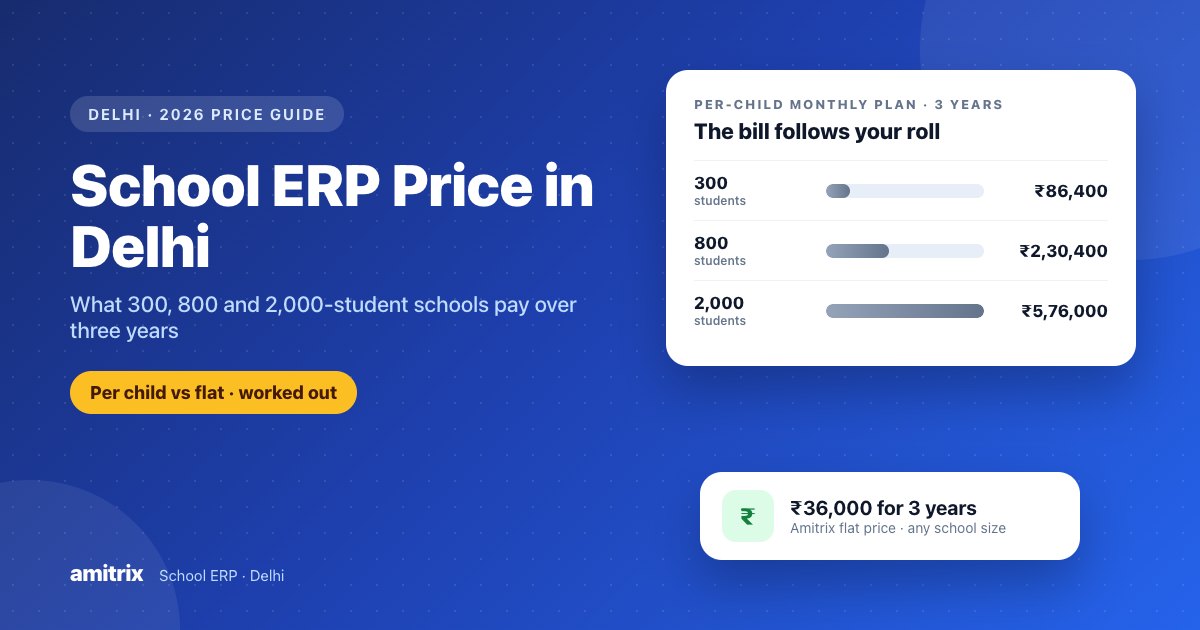
Ask five vendors about the school ERP price in Delhi and you will get five answers that cannot be compared. One quotes per child per month, another quotes per child per year, a third sends a flat monthly plan, and the fourth wants a one-time licence plus maintenance. None of them tells you what your own school will pay over the next three sessions.
This guide does that arithmetic for you. We take three school sizes that are common across Delhi - a 300-student primary or middle school, an 800-student school running up to Class 10 or 12, and a 2,000-student senior secondary campus - and calculate what each pricing model costs them in year one, over three years, and per student.
About the numbers: every rate below is an example level taken from prices vendors publish openly. They describe pricing models, not any named company. Real quotes vary, so use the tables to compare structures and then put each vendor's actual figures into the worksheet at the end.
School ERP Price in Delhi: The Short Answer
For a Delhi school, a school ERP usually costs somewhere between ₹12,000 and ₹2,00,000 a year, and the gap comes almost entirely from how the price is counted, not from what the software does.
- A small school of around 300 students sees quotes clustered fairly close together.
- A mid-sized school of 800 students starts to see per-child pricing pull away from the rest.
- A large school of 2,000 students can pay ten times more on one model than on another for the same set of modules.
So the first question to ask a vendor is not "how much?" but "how is the price counted, and what happens to it when our roll changes?"
How Vendors Count the Price
Delhi vendors use the same four models seen across India. Our school ERP pricing guide explains each in depth, so here is only the one line you need for the maths that follows:
| Model | Example level used in this guide | What the bill follows |
|---|---|---|
| Per child, monthly | ₹8 for each student every month | Your enrolment, twelve times a year |
| Per child, yearly | ₹50 for each student every year | Your enrolment, once a year |
| Flat monthly plan | ₹4,000 a month | A fixed amount (some vendors raise the tier as you grow) |
| Licence + AMC | ₹40,000 once, then 20% a year | Upfront spend, then maintenance, plus your own hosting |
| Flat yearly, unlimited students (Amitrix EMS) | ₹12,000 a year | A fixed amount, whatever your enrolment |
Price by School Size: 300, 800 and 2,000 Students
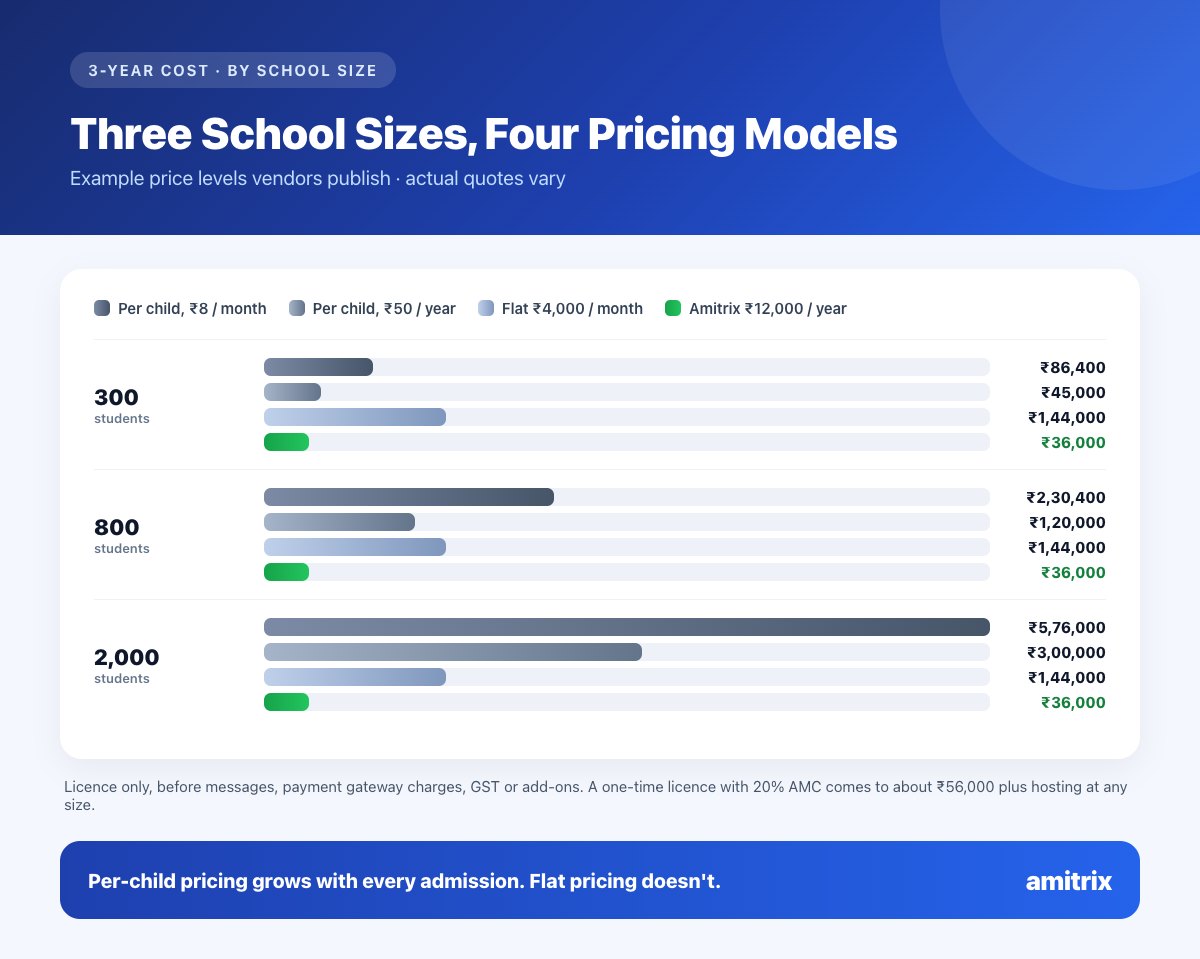
Here is what each model costs the three schools, before any add-ons. Each cell shows the first-year cost, then the three-year total.
| Model | 300 students | 800 students | 2,000 students |
|---|---|---|---|
| Per child, monthly (₹8) | ₹28,800 · ₹86,400 | ₹76,800 · ₹2,30,400 | ₹1,92,000 · ₹5,76,000 |
| Per child, yearly (₹50) | ₹15,000 · ₹45,000 | ₹40,000 · ₹1,20,000 | ₹1,00,000 · ₹3,00,000 |
| Flat monthly plan (₹4,000) | ₹48,000 · ₹1,44,000 | ₹48,000 · ₹1,44,000 | ₹48,000 · ₹1,44,000 |
| Licence + 20% AMC | ₹40,000 · ₹56,000 + hosting | ₹40,000 · ₹56,000 + hosting | ₹40,000 · ₹56,000 + hosting |
| Amitrix EMS | ₹12,000 · ₹36,000 | ₹12,000 · ₹36,000 | ₹12,000 · ₹36,000 |
The 300-student school
At this size the models sit close together. A per-child yearly plan at ₹15,000 is not far from a flat ₹12,000 price, and the difference may come down to what each plan includes. For a small school, inclusions matter more than the headline: check that the parent app, report cards and data transfer are part of the price, because one paid add-on can double a small bill.
The 800-student school
This is where per-child monthly pricing starts to hurt. ₹76,800 a year is more than six times a flat ₹12,000 plan, and the gap widens every year the school grows. An 800-student school also tends to need everything at once - transport, exams, a fee committee's reports - so module-based pricing can add up quickly.
The 2,000-student school
A large campus feels the counting method most. Under per-child monthly pricing the school is paying nearly ₹2 lakh a year, close to ₹6 lakh over three years, for software whose running cost hardly changes with enrolment. Large schools also tend to run more than one campus, so ask early how a second branch is priced.
We will show the full system running for a school of your size, with every module switched on.
Book a free demo →Cost Per Student: The Number That Tells the Truth
Dividing the yearly bill by the number of students shows who is really paying more. These are year-one figures.
| Model | 300 students | 800 students | 2,000 students |
|---|---|---|---|
| Per child, monthly (₹8) | ₹96 per student | ₹96 per student | ₹96 per student |
| Per child, yearly (₹50) | ₹50 per student | ₹50 per student | ₹50 per student |
| Flat monthly plan (₹4,000) | ₹160 per student | ₹60 per student | ₹24 per student |
| Amitrix EMS (₹12,000) | ₹40 per student | ₹15 per student | ₹6 per student |
Two patterns stand out. Per-child pricing never gets cheaper per student, however large you become. Flat pricing gets cheaper per student with every child you admit - which is exactly the direction a growing Delhi school wants its costs to move.
What Happens When Your School Grows
Most quotes are written for this year's roll. Very few schools stay that size.
Take the 800-student school and assume it grows by about 10% a year - a realistic pace for a school that adds a section in its entry classes:
| Session | Students | Per child, monthly (₹8) | Flat yearly (₹12,000) |
|---|---|---|---|
| Year 1 | 800 | ₹76,800 | ₹12,000 |
| Year 2 | 880 | ₹84,480 | ₹12,000 |
| Year 3 | 968 | ₹92,928 | ₹12,000 |
| Three-year total | - | ₹2,54,208 | ₹36,000 |
Growth that should be good news for the school quietly raises the software bill by more than ₹16,000 in two years on the per-child model. On a flat price, a stronger admission season changes nothing.
Ask every vendor two plain questions: What will we pay if we admit 150 more students? and By how much can the price rise at renewal? Get both answers in writing.
Costs That Sit Outside the Quote
The table prices are only the licence. Delhi schools tend to meet the following extras in their first year, and each one should be confirmed in writing before you compare quotes:
- Messages to parents. Absence alerts, fee reminders and closure notices on GRAP days are usually charged per SMS or per WhatsApp message.
- Online payment charges. Find out whether the school or the parent bears the gateway fee when fees are paid by UPI or card.
- Hindi report card templates. Some vendors treat a Hindi CBSE format as a custom job.
- Fee committee reports. Head-wise collection reports are central under Delhi's 2025 fee law; check they are standard, not a paid customisation.
- Freeship and EWS/DG handling. Confirm that concession seats are handled without extra modules.
- A second campus in the NCR. Many Delhi trusts also run a school in Noida, Ghaziabad or Gurugram; ask whether branch two is a new licence. Those campuses follow their own state's fee rules - see our guides for Noida and Gurgaon.
- Moving your old records. Data transfer and training can be quoted separately, especially mid-session.
- GST and renewal terms. Check whether the quote includes GST and whether the contract allows a yearly increase.
A One-Page Budget Worksheet
Copy this table into a spreadsheet and fill one column for each vendor. Compare the bottom line, not the first row.
| Line item | Vendor A | Vendor B | Vendor C |
|---|---|---|---|
| Licence, year 1 | |||
| Licence, years 2 and 3 (at your expected roll) | |||
| Parent app | |||
| Messages (SMS / WhatsApp) for a year | |||
| Payment gateway charges borne by the school | |||
| Data transfer and training | |||
| Report card formats (Hindi, Holistic Progress Card) | |||
| Extra branch, if any | |||
| GST | |||
| Three-year total |
Delhi's Directorate of Education publishes fee orders and circulars for private schools on its official website, so check the current rules before you finalise the budget. When your accounts are reviewed by a fee committee that includes parents, a software cost you can state in one line - and that will not move when admissions rise - is also easier to explain.
We will fill the worksheet with you, line by line, for your own school.
Book a free demo →How Amitrix Pricing Works
Amitrix EMS charges one flat price of ₹12,000 a year for the whole institution:
- unlimited students and parent logins
- every module, including fees, admissions, attendance, exams, transport and the parent app
- CBSE report cards in English and Hindi
- data transfer and staff training at no extra charge
- no per-student fee, so admissions never change the bill
The full breakdown is on our pricing page, and our School ERP in Delhi page explains how the system follows the Delhi school calendar. If you are still shortlisting, the Delhi buyer's checklist covers features to test in every demo.
Frequently Asked Questions
What is the price of school ERP software in Delhi?
It depends mainly on the pricing model. Using example levels vendors publish, an 800-student Delhi school pays roughly ₹40,000 to ₹77,000 a year on per-student plans, around ₹48,000 on a flat monthly plan, and ₹12,000 a year on Amitrix EMS's flat price.
Is per-student or flat pricing better for a Delhi school?
Per-student pricing can look cheap for a very small school, but the bill grows with every admission and never falls per student. Flat pricing keeps the cost fixed, so it becomes cheaper per student as the school grows.
What is the cheapest school management software for a small school in Delhi?
Compare the three-year total including the parent app, messages, data transfer and report cards, not just the licence. A low licence with paid add-ons can cost more than a slightly higher price that includes everything.
Do I have to pay extra for each branch of my school?
Many vendors license each campus separately. Ask before you sign, especially if your trust runs or plans a second school in Delhi or the NCR.
Are there hidden costs in school ERP pricing?
The usual ones are messaging credits, payment gateway charges, custom report card formats, data transfer, training, GST and yearly price increases at renewal. Ask for each in writing.
How much does Amitrix EMS cost?
₹12,000 a year for the whole institution, with unlimited students and every module included.
Conclusion
The school ERP price in Delhi is less about the software and more about the counting method. On per-child pricing, a 2,000-student campus can pay close to ₹6 lakh over three years; on a flat price, the same school pays ₹36,000. Small schools see smaller gaps, but they are the most exposed to paid add-ons.
Before you sign, work out the three-year total at the roll you expect, ask how the bill changes when you grow, and get every inclusion in writing.
Want to see the real cost for your school? Book your free Amitrix demo today.