
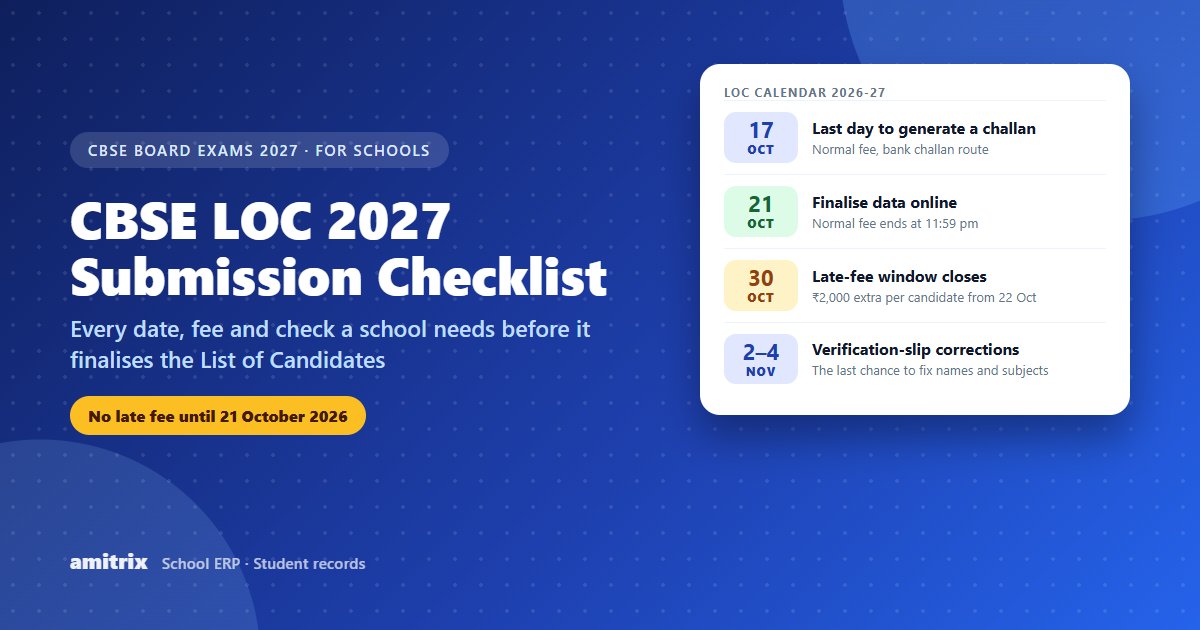
In short: For the CBSE LOC 2027, schools must finalise the List of Candidates for Class 10 and Class 12 and pay the fee by 21 October 2026 (by 17 October if paying through a bank challan). From 22 to 30 October a late fee of ₹2,000 per candidate applies. After the last date, each school prints a data verification slip and can fix names, dates of birth and subjects only between 2 and 4 November 2026. The APAAR ID is optional.
The List of Candidates (LOC) is the list a school sends to the Central Board of Secondary Education (CBSE) of every student who will sit the board examination. CBSE calls it the most important step before the exams, and with reason: the names, dates of birth and subjects you submit are what get printed on admit cards, question-paper allocations and, finally, the marksheet.
This guide is aimed at the principals, exam coordinators and office staff who sit at the portal and file the list. It turns CBSE's 55-page circular for 2026-27 into dates, a working order, the checks that catch most errors, and a worked example of what a missed deadline costs.
Source: Every date, fee and rule below comes from CBSE's circular Submission of List of Candidates (LOC) for Class X and Class XII Main Examinations 2026-27, dated 17 September 2026. If CBSE issues a revision, the circular on cbse.gov.in takes priority over this page.
CBSE LOC 2027 Dates and Fees at a Glance
The LOC opened on 24 September 2026. What matters most is the last date, which depends on how the school pays.
| Window | Online | Bank challan |
|---|---|---|
| Normal fee | 24 Sep to 21 Oct 2026 | 24 Sep to 17 Oct 2026 |
| Late fee | 22 to 30 Oct 2026 | 22 to 26 Oct 2026 |
| Corrections | 2 to 4 Nov 2026 | 2 to 4 Nov 2026 |
A challan must be generated by its last date and the money deposited within the challan's validity. The late fee is ₹2,000 per candidate, on top of the normal fee, whichever way you pay. "Corrections" means the data verification slip window explained below.
For schools in India, the fees per candidate are:
| Fee head | Amount |
|---|---|
| Examination fee, up to five subjects | ₹1,600 |
| Each additional subject | ₹320 |
| Class 12 practical fee, per practical subject | ₹160 |
| Late fee (from 22 October) | ₹2,000 |
| Visually impaired candidates | Exempt from the examination fee |
The portal closes at 11:59 pm on each last date, and CBSE has said there will be no extension. The circular also warns that the site slows down on the final days, so plan to finish at least a few days early.
The LOC Process Step by Step
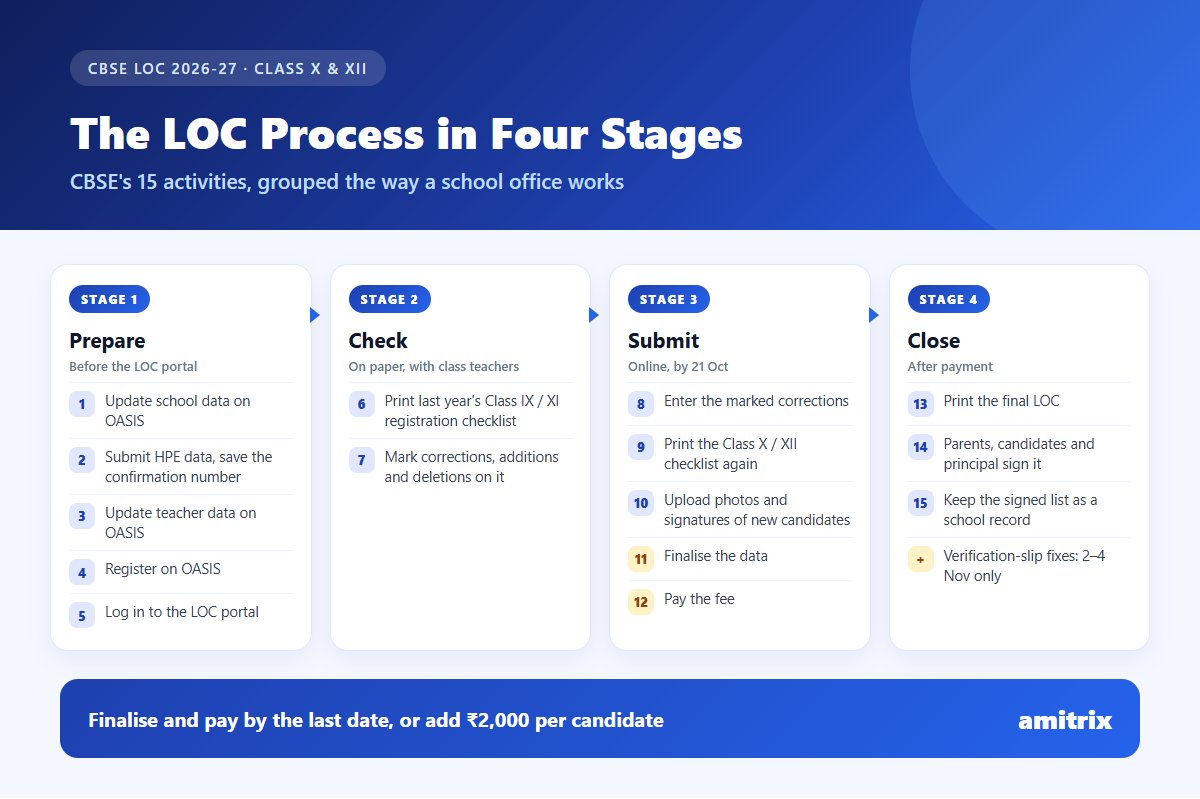
CBSE lists 15 activities to be done in sequence. Grouped the way a school office works, they fall into four stages.
Stage 1: prepare the school's data
- Update the school's data on OASIS, CBSE's school information portal. Fill in sections and student strength carefully: you cannot change the declared section or strength after the LOC is submitted.
- Submit the Health and Physical Education (HPE) data on the HPE portal and keep the confirmation number it generates. The LOC cannot be finalised until this is done.
- Update teacher data on OASIS. List as Trained Graduate Teachers (TGTs) and Post Graduate Teachers (PGTs) only those who actually teach Classes 9-10 and 11-12, write full names with no abbreviations or salutations, and remove teachers who have left.
- Register on OASIS and log in to the LOC portal using the school's affiliation number as the user ID.
Stage 2: check last year's list on paper
- Print the checklist of the students you registered in Class 9 and Class 11 last year. The LOC portal starts from this data.
- Mark every change on the printout: corrections to details, students to add, and students to delete.
Stage 3: submit online
- Enter the marked corrections, then print the Class 10 or Class 12 checklist again and compare it line by line.
- Upload photographs and signatures for new candidates, and for any student whose photograph was not uploaded at Class 9 or 11 registration.
- Finalise the data, then pay the fee. All students in a fee slab go in one lot; CBSE does not accept partial lists.
Stage 4: close the loop
- Print the final LOC, have it signed by parents or candidates and the principal, and keep it as a school record. The upload itself is signed with an e-signature linked to the principal's Aadhaar.
The whole submission is online only. There is no Excel upload in the LOC module, because only small corrections are expected at this stage, which is one more reason to get the Class 9 and 11 registration right.
Checking Names, Categories and Subject Codes
CBSE's list of precautions is short, and almost every LOC error falls under it:
- Spellings of the student's, mother's, father's and guardian's names must match the school's Admission and Withdrawal Register.
- Dates of birth must match the same register.
- Subject combinations must follow the Scheme of Studies. A combination outside the scheme is not accepted, and the candidate is treated as not eligible.
Who stays, who goes, who is added
- Delete students who have left the school by transfer or for other reasons, and Class 9 or 11 students who did not pass.
- Add a student admitted directly into Class 10 or 12, or a re-admission, only after approval from your CBSE Regional Office. CBSE has warned that unapproved additions can be rejected at any stage, with action against the school.
- Sponsor every eligible regular student. The school must not leave a bona fide student out, and must not include anyone who does not meet the attendance rule. Our guide to the CBSE 75% attendance rule explains how to track that through the year.
- Choose the category exactly as the circular defines it (Annexure B for Class 12, Annexure C for Class 10). CBSE notes that a wrong category in the LOC produces a result in that category, which then has to be corrected after the result.
The subject codes that are mixed up most
CBSE singles out these pairs, where one wrong digit changes the paper a student receives:
| Class | Easily confused codes |
|---|---|
| Class 10 | Hindi A (002) / Hindi B (085); Urdu A (003) / Urdu B (303); Mathematics Standard (041) / Mathematics Basic (241) |
| Class 12 | Hindi Core (302) / Hindi Elective (002); English Core (301) / English Elective (001); Sanskrit Core (322) / Sanskrit Elective (022); Urdu Core (303) / Urdu Elective (003); Mathematics (041) / Applied Mathematics (241) |
A practical habit: ask each class teacher to read the printed subject codes aloud against the student's own timetable before anything is finalised. It takes ten minutes per section and catches the swaps that a quick visual check misses.
Class 10 and the Two Board Examinations
Under CBSE's two-board-examination policy for Class 10, the first examination in February-March is mandatory for every Class 10 candidate. This LOC is for that first examination, so every Class 10 student must be on it.
The LOC for the second examination is filled separately, after the first examination is over. Students can take only the subjects the school entered in this LOC, so a subject error now follows a student into the second chance as well.
CBSE also asks schools to hold an orientation for Class 10 students and their parents explaining the second examination. Combining it with the briefing on checking LOC data works well: one meeting, one printed checklist, one signature.
APAAR ID, Photographs and CWSN Data
APAAR ID is optional in the LOC. The circular states plainly that filling in the Automated Permanent Academic Account Registry (APAAR) ID is optional. If you do enter one, enter it with the family's consent to share it, and make sure the candidate's name matches the APAAR record, because CBSE validates it. If an ID is not available or not to be shared, choose the appropriate option. Our guide to the APAAR ID for school students covers consent and generation.
Photographs must be clear and against the right student. Schools that did not upload photos at Class 9 or 11 registration must do so before final submission.
Children with Special Needs (CWSN) data has an earlier deadline than the LOC itself. After it passes, no student can be added as CWSN, and requests for exam-time relaxations are not considered once the LOC is in. Collect certificates and records now.
Parents' income may be recorded as the parents state it, for scholarship purposes. CBSE says schools must not ask for income tax returns or other income proof.
Working Out Your LOC Fee (With an Example)
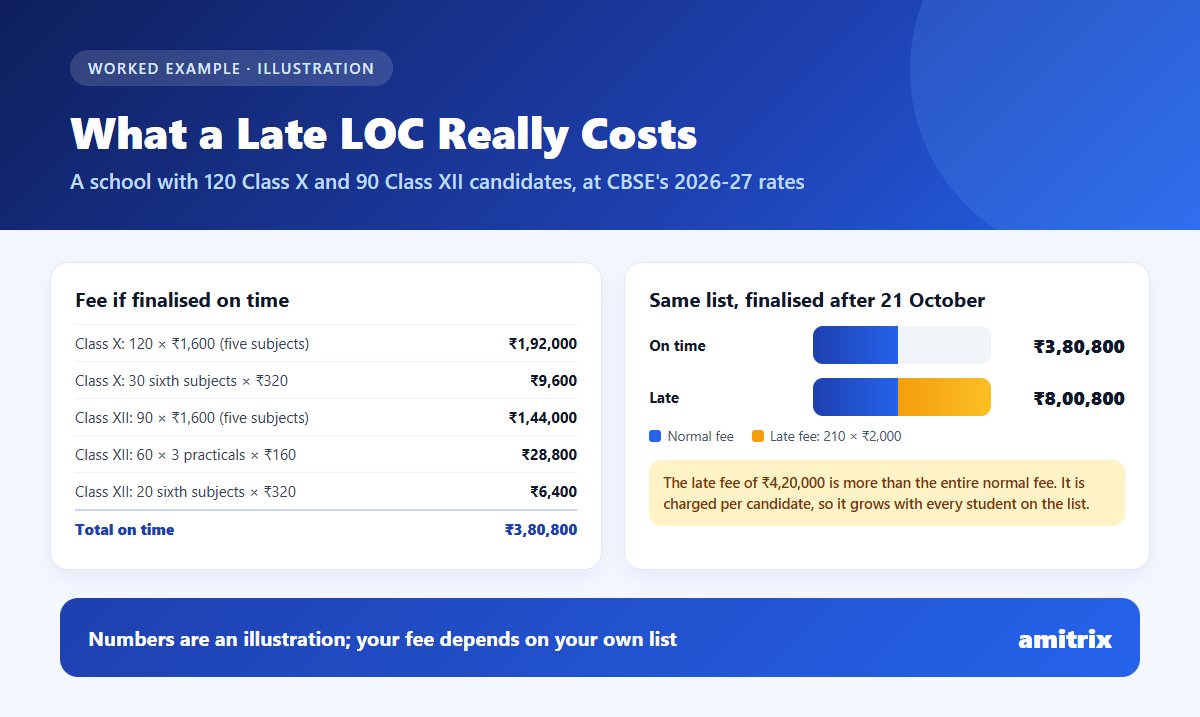
The fee is calculated from the date the data is finalised. If you finalise on or before the last date, you can pay without a late fee until that last date; miss it, and the late fee applies to every candidate.
Here is an illustration for a school with 120 Class 10 and 90 Class 12 candidates (the numbers are examples, not a real school):
| Item | Working | Amount |
|---|---|---|
| Class 10 examination fee | 120 × ₹1,600 | ₹1,92,000 |
| Class 10 sixth subjects | 30 × ₹320 | ₹9,600 |
| Class 12 examination fee | 90 × ₹1,600 | ₹1,44,000 |
| Class 12 practicals | 60 students × 3 practicals × ₹160 | ₹28,800 |
| Class 12 sixth subjects | 20 × ₹320 | ₹6,400 |
| Total if finalised on time | ₹3,80,800 | |
| Late fee if finalised after 21 October | 210 × ₹2,000 | ₹4,20,000 |
| Total if late | ₹8,00,800 |
The late fee alone is larger than the entire normal fee, because it is charged per candidate rather than per subject. That is the strongest argument for finalising early and fixing small errors later in the correction window.
After Finalisation: The 2-4 November Correction Window
Mistakes found before the last date can still be fixed by the school online. Correcting a name, adding or removing a surname, or replacing one subject with another costs nothing; adding a sixth subject means paying its extra fee.
After the last date, schools generate a data verification slip for each candidate. If the candidate's, mother's, father's or guardian's name, the date of birth or a subject is wrong, CBSE allows correction only from 2 to 4 November 2026. After that, the Board allows no corrections at all, and it has said it will not accept requests to change subjects just before the examinations.
Two habits make this window useful rather than stressful:
- Send each family its verification slip (or the details on it) with a short reply deadline, so corrections arrive before 2 November, not during it.
- Keep one person responsible. CBSE expects a single official to handle the LOC, and asks principals to take a daily status report from that person for the seven days before each last date.
CBSE has also listed the excuses it will not accept, including staff absence, students not giving their details, a student who stopped attending, and the school simply forgetting to finalise.
How Clean Student Records Make the LOC Easier
The LOC itself is filed on CBSE's portal; no school software submits it for you. What software can do is make sure the data you check against is right before you start, because most LOC errors begin months earlier, at admission or at Class 9 registration.
With Amitrix EMS, each student has one record from admission onwards: name, date of birth, parents' and guardians' details, and documents such as Aadhaar and transfer certificates, all kept together. Our Admissions & Student Directory and Examinations modules hold sections and subjects in the same place, so the list you print for class teachers to check comes from one source, not three spreadsheets. When existing students are brought in from Excel, the import is checked against the same rules. You can see it working on your own class list in a demo.
Because the LOC also asks schools to protect sensitive data like Aadhaar and income details, the features page explains how Amitrix encrypts and restricts access to student records. Pricing is one flat amount for unlimited students, set out on the pricing page.
We'll show you a section's student list ready to check against the CBSE checklist.
Book a free Amitrix demo →Accurate records also help with the other government portals a school fills in each year; our UDISE+ student module guide covers the same data from the UDISE+ side.
Frequently Asked Questions
What is the last date for CBSE LOC submission for the 2027 board exams?
The last date without a late fee is 21 October 2026 for online payment, and 17 October 2026 for generating a bank challan. With a late fee of ₹2,000 per candidate, schools can submit until 30 October 2026 online, or 26 October 2026 by challan.
What is the CBSE LOC fee for 2026-27?
For schools in India, the fee is ₹1,600 per candidate for up to five subjects, ₹320 for each additional subject, and ₹160 per practical subject for Class 12. Visually impaired candidates are exempt from the examination fee.
Is the APAAR ID mandatory for the CBSE LOC?
No. CBSE's 2026-27 LOC circular says filling in the APAAR ID is optional. If you enter one, the candidate's name must match the APAAR record, because CBSE validates it.
Can a school change a student's subject after submitting the LOC?
Only within the correction routes CBSE allows: before the last date, the school can correct data online, and between 2 and 4 November 2026 it can fix errors shown on the data verification slip. After that, CBSE has said it will not change subjects.
Do Class 10 students need a separate LOC for the second board exam?
Yes. This LOC covers the first, mandatory examination in February-March. The LOC for the second examination is filled after the first one is over, and students can take only the subjects entered in this LOC.
Can we add a student who joined Class 12 this year?
Only with approval from your CBSE Regional Office. Direct admissions and re-admissions in Class 10 or 12 can be added under the direct admission category after that approval.
Conclusion
The CBSE LOC 2027 rewards schools that start early and check carefully. Update OASIS and the HPE portal first, check last year's Class 9 and 11 list on paper with class teachers, watch the subject codes that are easy to swap, and finalise before 21 October. The 2-4 November window is a safety net for a few errors, not a plan for many.
Want student records that are ready for CBSE before the LOC opens? Book your free demo today.