
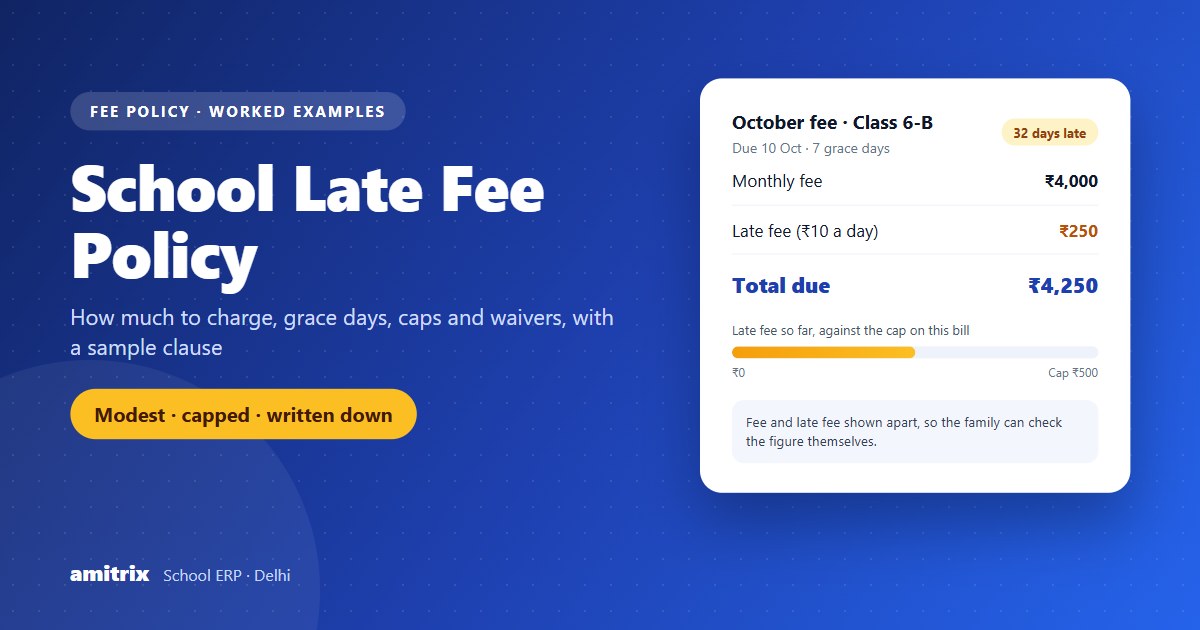
At ₹10 a day after a five-day grace period, the late fee on a ₹4,000 monthly bill reaches ₹850 by the 90th day, more than a fifth of the fee, unless the policy caps it. No national rule fixes the amount. It depends on your state's fee law and your approved fee structure, and a sound policy keeps the charge modest, caps it on each bill, publishes it before it's used and never uses it to stop a child's classes or results.
Sources: Rule 166 of the Delhi School Education Rules, 1973, the Delhi High Court judgment of 15 November 2022 and the 2025 Delhi Act and Rules, all linked below. Last reviewed 9 October 2026. General information, not legal advice.
What a School Late Fee Policy Must Answer
A school late fee policy is the written rule behind a late fee, often called a late fine. It decides when an unpaid fee becomes late, how much extra the family owes for paying late, and how that charge is limited, waived and communicated.
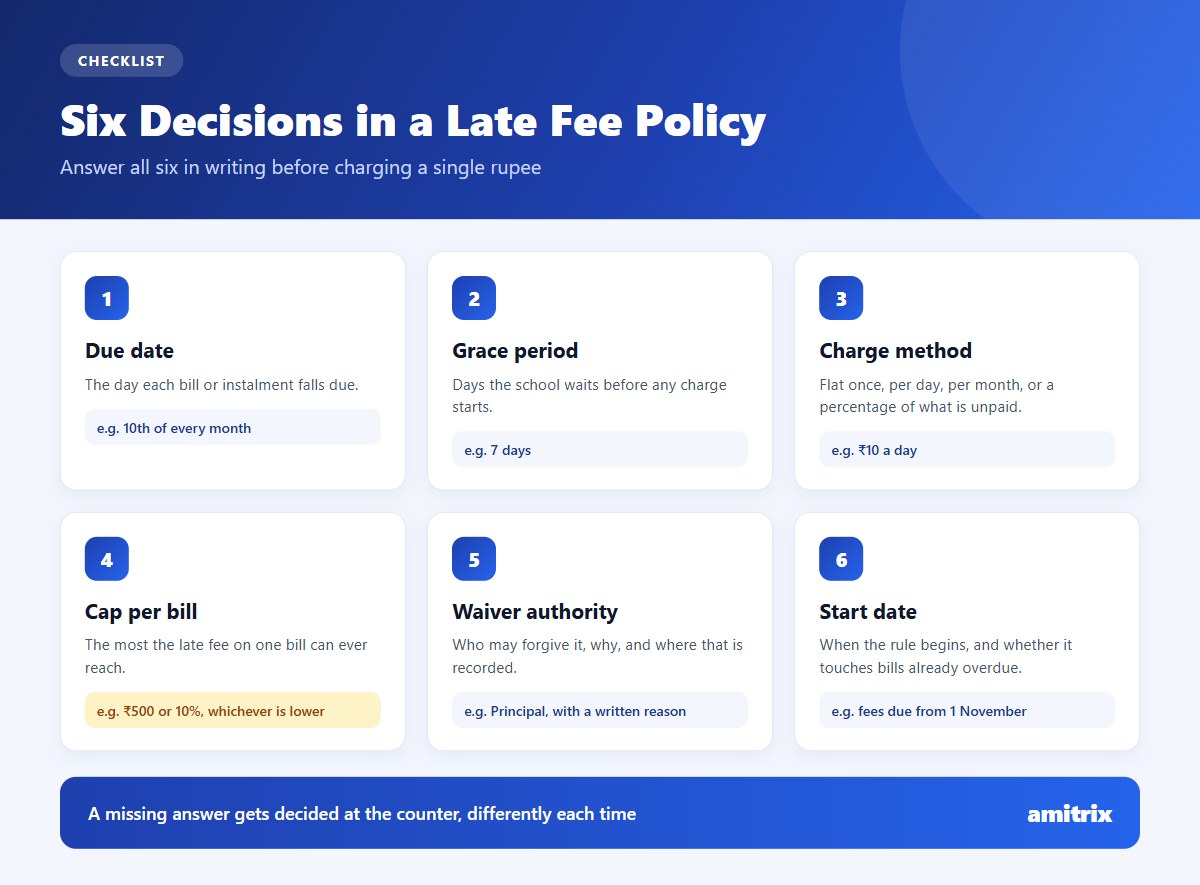
- The due date, such as "the 10th of the month", or one date per instalment.
- The grace period, meaning how many days the school waits before any charge starts.
- The charge method, whether a flat amount, a daily amount, a monthly amount or a percentage of what's unpaid.
- The cap, which is the most the late fee on one bill can ever reach.
- The waiver rule, saying who can forgive a late fee, why, and where that's recorded.
- The start date, which says when the rule begins and whether it touches bills already overdue.
Leave any of the six unwritten and the counter fills the gap differently each time, which is how two families with the same arrears end up paying different amounts.
Grace period
A grace period absorbs the delays that are nobody's fault, such as a salary credited on the 7th, a bank holiday or a UPI payment that took a day to show. A charge on day two feels unfair to a family whose salary arrived on day three, so five to seven days of grace removes most of that friction.
Cap
Set a cap on each bill, not just a rate. It can be a rupee figure such as ₹500, a percentage such as 10% of the bill, or both, with the lower one applying. A percentage scales fairly between a ₹1,500 pre-primary fee and a ₹9,000 senior secondary fee. Before fixing it, ask whether a parent committee would find the highest possible charge reasonable.
Holidays
Decide once whether the clock starts on the calendar date even when the school is closed, or on the next working day. The second is kinder when most parents pay at the counter.
Waivers
Late fees get waived for a medical emergency, a bank error or a parent who paid on time at the wrong counter, and that's fine as long as every waiver can still be explained six months later. Four habits make that possible:
- name who may waive (the principal, a director or the managing committee), not the accountant who collects the fee;
- record a reason every time;
- set a ceiling per waiver and per student per session;
- keep a register of waivers apart from ordinary fee concessions, and keep the reason off the parent's receipt.
Is a Late Fee Allowed? What the Rules Say
The answer changes with a school's status and with the year, as Delhi shows:
- Aided schools. Rule 166 of the Delhi School Education Rules, 1973 sets a fine of five paise a day, counted after the 10th of the month. The text is published by the Directorate of Education (DoE).
- Private unaided schools, before 2025. On 15 November 2022 the Delhi High Court held that Rule 166 does not bind private unaided schools, which have substantial autonomy over their fees (W.P.(C) 3616/2013, judgment text).
- Private unaided schools, under the 2025 Act. The Act defines "fee" through a list of heads, and a late fee is not one of them. The 2025 Rules treat any amount not approved under the Act as an "unjustified fee demand", and Section 13 bars harassing a student over unpaid or delayed fees.
We have not found a DoE order on late fees under the 2025 Act. Until there is one, the cautious course for a Delhi private school is to put its late-fee rule into the fee proposal before the School Level Fee Regulation Committee (SLFRC), and to take legal advice. How that committee works under the 2025 Act is covered separately. Schools in Uttar Pradesh and Haryana work under different fee rules, covered in the Noida and Ghaziabad checklist and the Gurgaon checklist for Haryana schools.
Four Ways to Charge a Late Fee, With a Worked Example
| Method | How it works | Drawback |
|---|---|---|
| Flat, once | One fixed amount once the grace period ends | No extra nudge for a bill unpaid for months |
| Per day | A fixed amount for every day after the grace period | Grows fast; needs a cap |
| Per month | A fixed amount for every full 30 days late | Nothing extra in the first month |
| % of fee | A percentage of the unpaid fee for every full 30 days late | Harder for parents to check by hand |
The same bill under all four methods
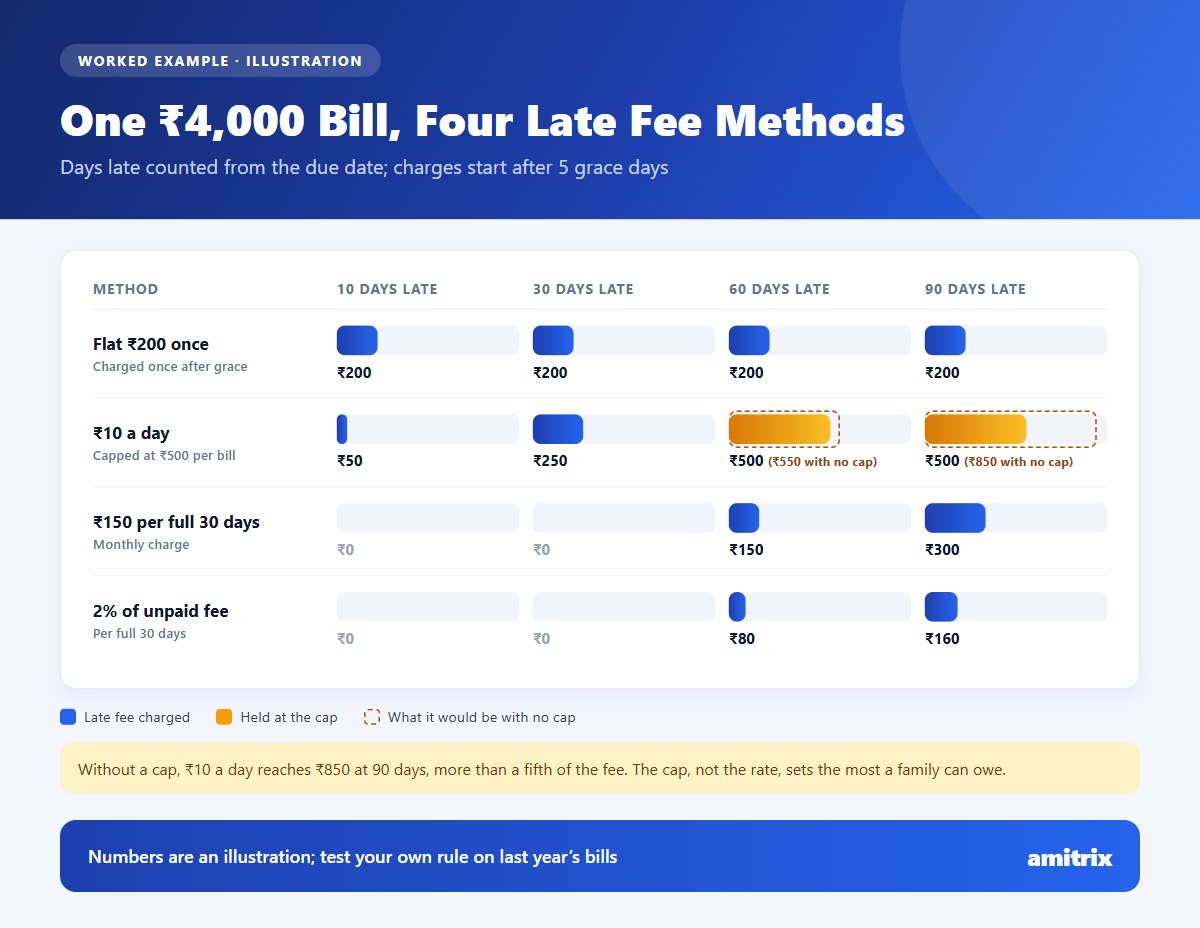
Take a monthly fee of ₹4,000, due on the 10th, with a 5-day grace period. "Days late" counts from the due date, but charges start only after the 5 grace days, so at 10 days late, ₹10 a day comes to ₹50. The monthly and percentage methods charge only for each full 30 days after the grace period.
| Method | At 10 / 30 / 60 / 90 days late |
|---|---|
| Flat ₹200 | ₹200 / ₹200 / ₹200 / ₹200 |
| ₹10 a day (cap ₹500) | ₹50 / ₹250 / ₹500 / ₹500 |
| ₹150 per 30 days | ₹0 / ₹0 / ₹150 / ₹300 |
| 2% per 30 days | ₹0 / ₹0 / ₹80 / ₹160 |
Look at the 10-day figures first. The per-day rate is already charging there, while the monthly methods haven't started, so it does most of its work early. That's also why it needs the cap more than any other method: the ₹500 limit is what stops it at ₹500 instead of ₹850. The flat charge has the opposite problem, since a family two months behind pays the same ₹200 as one that's a week late.
A Sample Late Fee Clause You Can Adapt
Adapt this to your own dates and amounts, have it checked against your state's rules, and publish it with your fee structure:
Late payment of fees. Fees are due on the 10th of each month. A grace period of 7 days applies. After that, a late fee of ₹10 per day is charged on the unpaid bill, up to ₹500 or 10% of the bill, whichever is lower. Payments are applied first to the fee and then to any late fee. Only the Principal or the Managing Committee may waive a late fee, with the reason recorded. This rule applies to fees falling due on or after 1 November 2026. Late payment will never affect a student's attendance in class, examinations or results.
Applying payments to the fee first stops instalment payers being trapped in penalties, and the last sentence tells parents what the school won't do.
Running the Policy in Amitrix
In Amitrix's fee management module the policy is a setting, not a clerk's arithmetic. You pick one of four methods (per day, per month, one-off, or a percentage of the balance), add grace days, and cap each bill in rupees, as a percentage or both, in which case the lower figure applies. Before the rule goes live, the preview shows its effect on your bills, and you decide whether it should also reach bills already overdue. The receipt prints the late fee on its own line, due slips show it before the parent reaches the counter, and the collection report adds up late fees charged, collected, waived and still outstanding. Each waiver goes into a separate register with the authority who granted it, the reason and the school's limits.
The ten tests for school fee management software cover the rest of the fee month, from monthly bills to the defaulter list. Late-fee settings come with the fee module under one yearly fee that covers every module.
Bring your due date, grace days and cap, and we'll show a sample bill's late fee building up until it stops at your cap.
Test your late fee rule →Frequently Asked Questions
Is it legal for a private school in India to charge a late fee?
Generally yes, when the charge is in the school's published fee rules and the state's fee law allows it. The strongest position is a late fee written into the approved fee structure itself, with its grace days and cap, because that's the document a parent or fee committee will ask to see.
How much late fee can a school charge?
Delhi's aided schools show how low a fixed rule can be: five paise a day works out to ₹1.50 for a bill paid 30 days after the 10th. For other schools the figure is whatever the approved fee structure sets, within the state's fee law.
How should a school introduce a new late fee?
Give parents at least one full billing cycle of written notice with the rule, the grace period and the cap, and don't back-date it: a new late fee on bills already overdue looks like a penalty invented after the fact, and it's the change most likely to be challenged. Before it starts, list how many families would be charged in the first month and the largest single charge, and say it in the fee reminder; template 9 among the school fee reminder messages is written for that step.
Can a school charge a late fee on a late fee?
A late fee should be worked out on the unpaid fee only, never on penalty already added; compounding penalties are hard to explain and harder to defend.
Should a late fee be shown separately on the fee receipt?
Show it as its own line, apart from the fee, so parents see exactly what they paid for, and the school can report late fees collected and waived without mixing them into fee income. Field 11 of a properly itemised school fee receipt is exactly that line.
Write the Six Answers Down This Week
Put the six decisions on one page, add the sample clause with your dates and amounts, and take it to whoever approves your fee structure: the managing committee, or the SLFRC in a Delhi private school.
Once it's approved, we can show you the rule at work, from a receipt with the late fee on its own line to a waiver entering the register.