
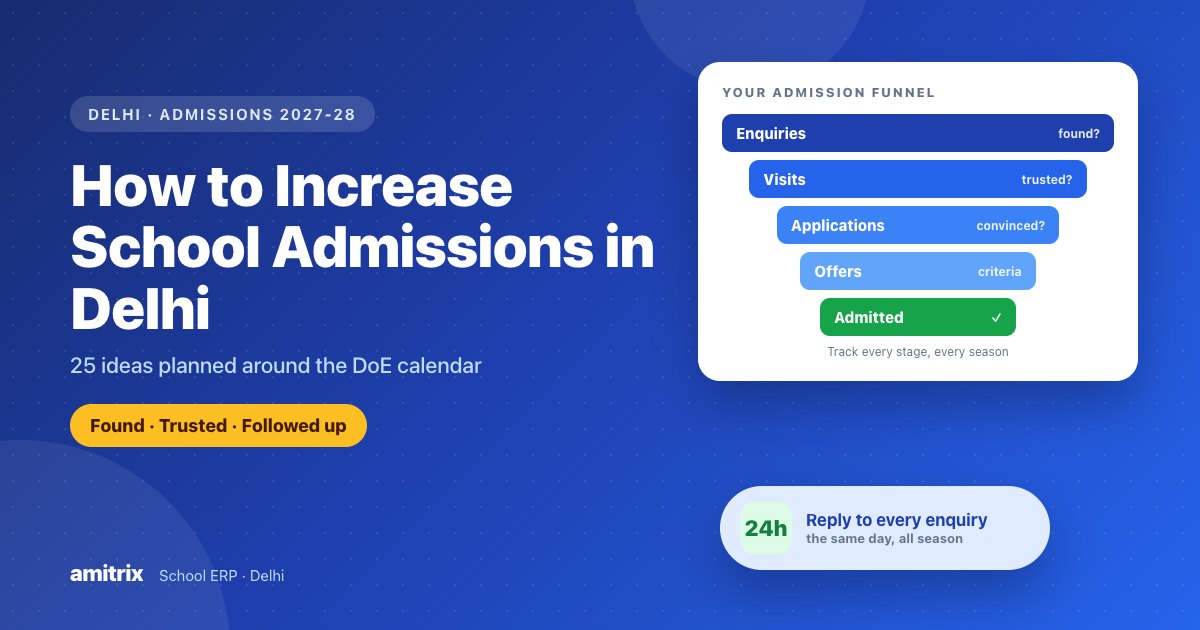
In short: To increase school admissions in Delhi, start before the DoE schedule is out: make your criteria, fees and dates easy to find, answer every enquiry the same day, run open houses that show daily school life, and track each enquiry from first call to admission. Delhi's rules (no interviews, capped registration fees, centrally allotted Economically Weaker Section (EWS) seats) mean trust and follow-up win families, not pressure.
Every Delhi school feels the same squeeze each winter. The DoE announces the entry-level schedule, parents shortlist a dozen schools in a weekend, and the schools that answer quickly and clearly fill their seats while the rest wonder where the enquiries went.
Most advice on how to increase school admissions is written for any school anywhere: post on social media, run ads, offer discounts. Delhi is different. Admissions to Nursery, KG and Class 1 run to a city-wide timetable, schools cannot interview children, registration charges are capped by law, and a quarter of entry seats are filled by the DoE's own draw. Those rules decide what actually works.
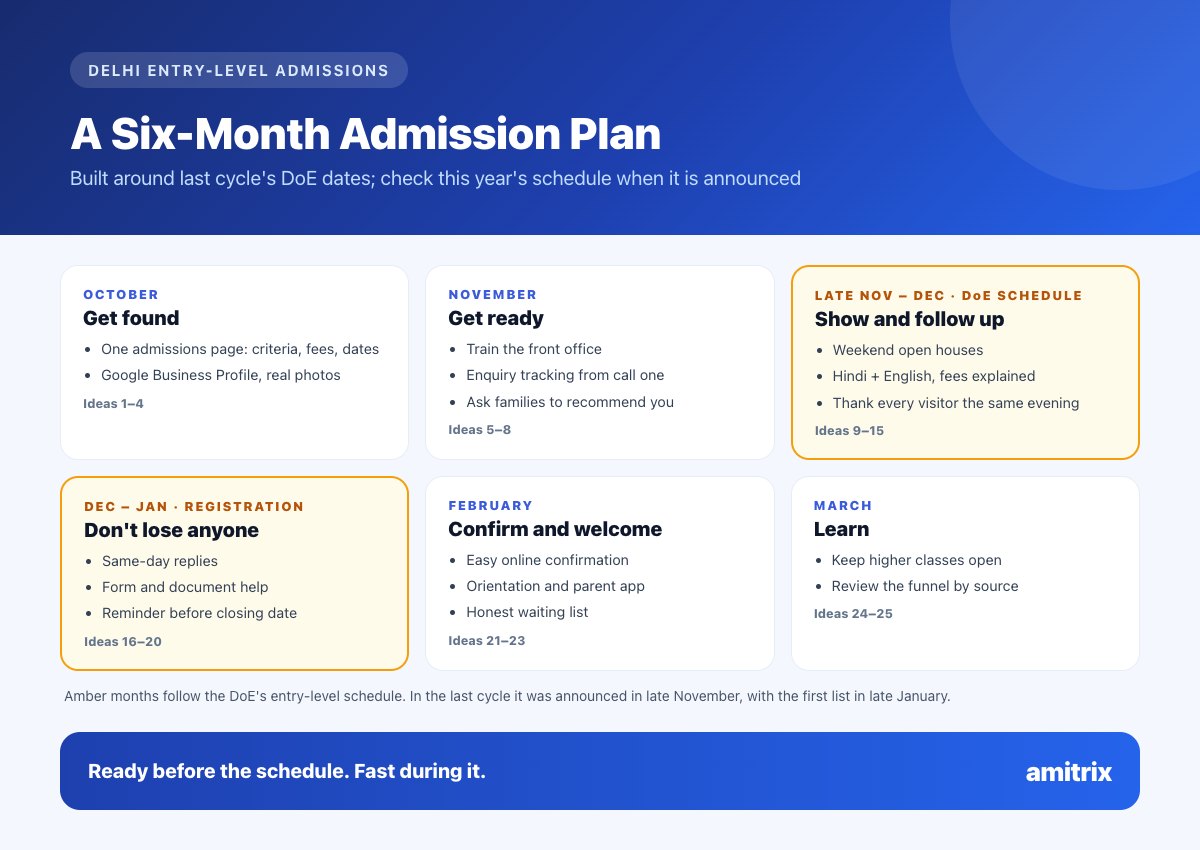
Below are 25 ideas grouped by the months in which they matter, built around the last DoE cycle, which opened in late November with registrations through December and the first list in late January.
Why Admissions Work Differently in Delhi
Four Delhi rules shape every admission campaign:
- A fixed calendar. The Directorate of Education sets the entry-level schedule for every private unaided recognised school. Parents compare schools in the same few weeks, so being ready early matters more than spending more.
- No interviews or tests for the child or parents at entry level. You win families by what you show and explain, not by selecting them.
- Capped admission charges. Under the 2025 Rules made under Delhi's fee law, registration is capped at ₹25 and the admission charge at ₹200, and fees are set through a committee that includes parents. Our Delhi Fee Regulation Act checklist has the detail. Transparent fees are now a selling point, not a risk.
- Reserved seats are allotted centrally. 25% of entry seats go to EWS, DG and CWSN children through the DoE's draw. See our EWS and DG admission guide for the school's side.
Your campaign is therefore about the open seats, and about making your school the obvious choice in a short, crowded window.
Before the Season: Get Found and Trusted (October–November)
1. Publish everything a parent needs on one admissions page. Points criteria, age limits, the fee structure, documents needed and last year's dates, all on one page that is linked from your home page. Parents shortlist schools whose rules they can understand in a minute.
2. Show the fee structure, head by head. A clear fee chart with every head itemised answers the question parents are most nervous about. Under the 2025 law it also shows you have nothing to hide.
3. Complete your Google Business Profile. Correct address, phone, timings, photos of real classrooms and the admissions page link. Parents often start with a "schools near me" search on a map. Ask happy parents for honest reviews; never write or buy them.
4. Photograph daily school life. Real classrooms, the library, play areas, the bus bay at pick-up time. Stock photos tell a parent nothing about your school.
5. Make enquiring effortless. One short online form, a WhatsApp number that someone actually answers, and a phone line staffed during the evening hours when working parents call.
6. Train the front office. The person who answers the first call is your most important admission officer. Give them a one-page guide: criteria, fees, transport routes, visit slots, and what to say when they don't know.
7. Set up enquiry tracking before the first call. Record every enquiry with its source, the child's class, and a status (enquired, visited, applied, admitted, lost). Without this, you cannot tell which idea worked.
8. Ask current families to recommend you. A simple, polite request in a parent newsletter or at a PTM, and a "how did you hear about us?" question on every enquiry form, so you can see which recommendations bring admissions.
Open Houses and Visits That Convert (November–December)
9. Run open houses at weekends. Working parents in Dwarka, Rohini and Mayur Vihar can rarely visit on a weekday morning. Two weekend slots a month through the season are worth more than one large event.
10. Show a normal day, not a stage show. Let parents see a class at work, the reading corner, lunch arrangements, and how teachers speak to children. Parents of three-year-olds are judging care and safety first.
11. Explain safety, transport and the winter plan. Bus routes and stops, how children are handed over at pick-up, and what you do when a Graded Response Action Plan (GRAP) order moves classes to hybrid mode. Our GRAP hybrid classes plan is a good basis for that answer.
12. Speak and print in Hindi and English. Many Delhi families are more comfortable in Hindi. A bilingual prospectus and a teacher who can answer in either language remove a quiet barrier.
13. Show what parents will receive. A sample report card, the parent app, a week of homework in the digital diary. "You'll always know how your child is doing" is a promise you can demonstrate.
14. Let parents ask about fees openly. Have someone at every open house who can explain each fee head, the payment schedule and online payment, without pressure.
15. Follow up within a day. Thank every visiting family the same evening and share the admissions page link. A visit with no follow-up is an admission you have handed to the next school.
See how the Admissions module tracks every enquiry → from first call to final list, with the source of each one recorded. Prefer to see it live? Book a free demo.
During Registration: Don't Lose Enquiries (December–January)
16. Answer the same day, every day. In registration season, a reply the next morning can be too late. Set a rule and check it daily.
17. Help with forms and documents. Publish a document checklist, and offer a help desk at school for parents who struggle with online forms. Accurate applications also mean fewer disputes when lists go up.
18. Explain your points criteria in plain words. A worked example ("a child who lives 3 km away with a sibling in the school scores…") prevents dozens of phone calls. Our nursery admission guide covers designing criteria that hold up.
19. Send reminders before the closing date. One polite message a few days before registration closes, to every family that enquired but has not applied, sent only to families who agreed to hear from you.
20. Publish lists on time and handle queries calmly. A school that meets every DoE date and answers questions with clear records earns a reputation that carries into next year.
After the Lists: Confirm, Welcome and Learn (February–March)
21. Make confirming a seat easy. Online fee payment, a clear deadline and a named person to call. Families with offers from several schools often choose the one that made the last step simplest.
22. Welcome new families early. An orientation session, the school calendar, uniform and book lists, and parent app access before the session starts.
23. Manage the waiting list openly. Tell waitlisted families honestly where they stand and when they will hear. Many accept later, and all of them remember how they were treated.
24. Keep doors open beyond entry classes. Families move to Delhi through the year. Keep the admissions page live for Class 2 and above, with clear vacancy information.
25. Review the season with numbers. Which sources brought enquiries that became admissions, where families dropped out, and why lost families chose elsewhere. That review is the start of next year's plan.
Track Your Admission Funnel
Every idea above works only if you can see its effect. Track five stages for each entry class. The numbers below are an illustration of how to read the funnel, not a benchmark:
| Stage | Example count | What it tells you | If it drops sharply |
|---|---|---|---|
| Enquiries | 300 | Are you being found? | Work on ideas 1–5 and 8 |
| Visits | 120 | Do enquiries trust you enough to come? | Faster replies, clearer fees (ideas 2, 6, 15) |
| Applications | 90 | Did the visit convince them? | Improve open houses (ideas 9–14) |
| Seats offered | 70 | Your criteria and seat count | Check criteria and lists (ideas 18, 20) |
| Admissions confirmed | 60 | Did the last step work? | Simplify confirmation (ideas 21–23) |
Keep the same five stages every year, and record the source of each enquiry (website, Google, referral, walk-in, banner). After one season you will know where your next rupee and hour should go.
What Not to Do
- Don't charge more than the law allows at registration or admission, and never ask for a donation or "development contribution" to secure a seat.
- Don't interview or test children for entry-level seats.
- Don't make claims you can't prove, such as rankings, awards or results you can't show evidence for.
- Don't send promotional messages to families who haven't agreed to them. Consent matters for parents' data; see our Digital Personal Data Protection (DPDP) Act guide for schools.
- Don't pressure families with "only today" offers. Delhi parents talk to each other, and the season is short.
How Amitrix Helps Schools Fill Their Seats
Amitrix EMS doesn't run your marketing, but it keeps the admission machine behind it working:
- Online enquiry and application forms that feed straight into one admissions list
- Status for every applicant, from enquiry to admission, so no family is forgotten
- Document uploads attached to each application
- One parent login for siblings, and parent app access from the first day
- Itemised fee structures and online payment, so confirming a seat takes minutes
- Bulk enrolment from Excel once your final list is ready
It costs one flat ₹12,000 a year for unlimited students, as shown on our pricing page. See how it fits the rest of the Delhi school year on our school ERP for Delhi page.
We'll show you an admission season, from first enquiry to confirmed seat, on your own classes.
Book a free demo →Frequently Asked Questions
How can a private school increase admissions in Delhi?
Be ready before the DoE schedule is announced: publish your criteria, fees and dates on one clear admissions page, keep your Google Business Profile complete, answer every enquiry the same day, run weekend open houses that show real school life, and track each enquiry until it becomes an admission or a lost lead.
When should Delhi schools start planning admissions for 2027-28?
In October and November. In the last cycle, the DoE announced the entry-level schedule in late November, with registrations through December and the first list in late January, so most parents shortlist schools before December.
Can Delhi schools interview children for nursery admission?
No. Entry-level admissions in Delhi do not allow interviews or tests of the child or parents. Schools select through their published points criteria within the DoE's rules.
How much can a Delhi school charge for admission registration?
Under the 2025 Rules made under Delhi's fee law, the registration charge is capped at ₹25 and the admission charge at ₹200, with refundable caution money capped at ₹500.
Does online marketing help school admissions?
Yes, when it helps parents find accurate information quickly: a complete Google Business Profile, a clear admissions page, honest reviews and real photos. It works best together with fast replies and well-run visits.
How do I know which admission ideas are working?
Track five stages (enquiries, visits, applications, offers and confirmed admissions) and the source of each enquiry. Comparing them across seasons shows where families drop out and which sources bring real admissions.
Conclusion
Learning how to increase school admissions in Delhi means planning for a short, rule-bound season: be easy to find and easy to understand before the DoE schedule arrives, show parents real school life, answer quickly, explain fees openly, and follow every enquiry to the end.
Pick five ideas from this list for this season, track the funnel, and add five more next year. The schools that fill their seats are rarely the loudest; they are the ones parents found easiest to trust.
Want an admission season you can see end to end? Book your free Amitrix demo today.