
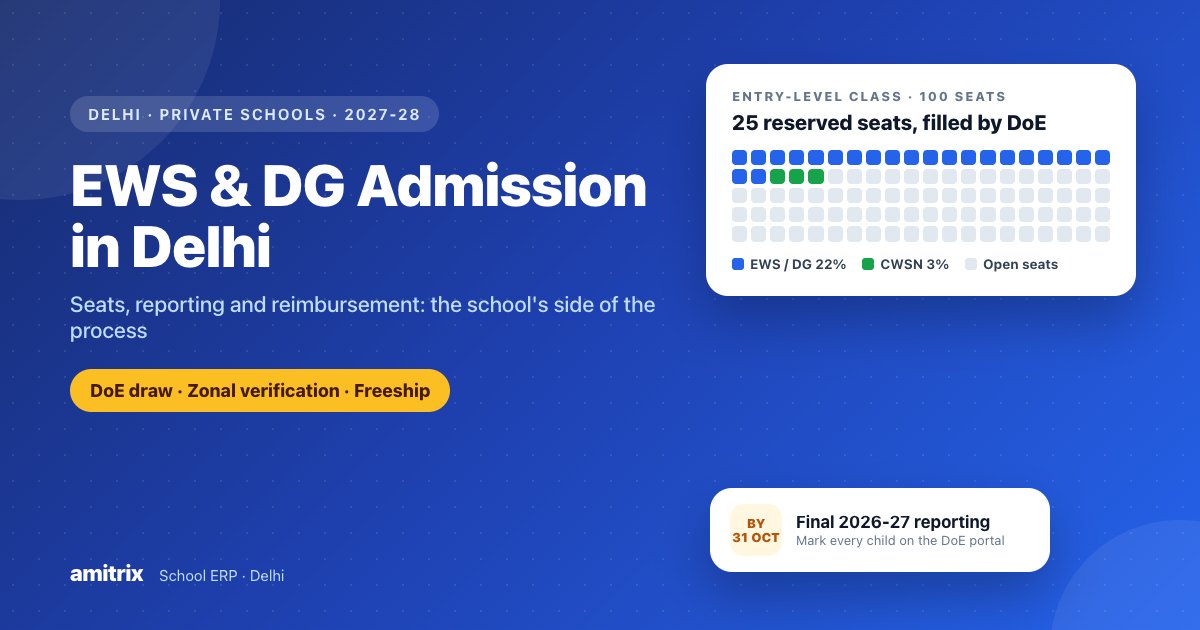
In short: Delhi's private unaided schools fill 25% of entry-level seats (22% Economically Weaker Section and Disadvantaged Group (EWS/DG), 3% CWSN) through the DoE's computerised draw. The DoE verifies documents; the school admits each recommended child without re-checking, marks them "Reported" on the portal, charges no tuition fee, gives free books within a week and keeps the records its reimbursement depends on. The EWS income limit is below ₹5 lakh.
Most of what is written about Delhi EWS admission is for parents: how to apply, which documents to upload, when the draw results come out. Very little explains the other side of the process, which is what a private school has to do once the Directorate of Education (DoE) sends it a child.
That side matters. The allotment comes as an order the school cannot argue with, the reporting status has to be marked on a government portal, free books and writing material are due within a week, and the reimbursement claim depends on records the school keeps all year.
This guide covers the school's side for the 2027-28 session, using the rules and dates of the 2026-27 cycle as the reference. The final round of 2026-27 is still running: children recommended after the last draw can report to their schools until 31 October 2026.
Sources and caution: This guide is general information, not legal advice. It is based on DoE circulars for 2026-27 published on the official EWS/DG admission portal, the DoE's income notification of December 2024 and the RTE Act. The 2027-28 schedule has not been announced; dates for that session are expected, based on the last cycle. Follow the DoE's circulars for your school.
Delhi EWS Admission: The 25% Rule for Private Schools
Under Section 12(1)(c) of the Right of Children to Free and Compulsory Education (RTE) Act, private unaided schools admit at least 25% of their entry-level class from children of weaker sections and disadvantaged groups, and educate them free until elementary education is complete.
In Delhi this works as follows:
- Who: every private unaided recognised school, at its entry level. Minority schools are exempt.
- Entry classes: Nursery (pre-school), KG (pre-primary) and Class 1.
- The split: 22% of seats for EWS and DG children and 3% for children with special needs (CWSN), within the 25%.
- Also included: private unaided schools recognised by the MCD or NDMC up to Class 5 take part in the same draw.
- How seats are filled: centrally, through the DoE's computerised draw, not through the school's own points system.
Your general nursery admissions run alongside this on a separate track. Our guide to running nursery admissions for 2027-28 covers the open seats; this guide covers the reserved ones.
Who Qualifies for EWS, DG and CWSN Seats
| Category | Who | Proof the family uploads |
|---|---|---|
| EWS | Families living in Delhi with a total annual income below ₹5 lakh from all sources | Income certificate from the Delhi government's Revenue Department, issued before the last date of application, or a Delhi BPL/AAY or food security card |
| DG | SC, ST and OBC (non-creamy layer) children, orphans, transgender children, and children living with or affected by HIV | Category certificate (OBC families also need the non-creamy layer certificate). No income certificate is needed |
| CWSN | Children with a benchmark disability (40% or more) | Disability certificate from a government hospital |
The income limit was raised to under ₹5 lakh by a DoE notification of 23 December 2024. It had been under ₹1 lakh for years, and briefly under ₹2.5 lakh.
Age for the 2026-27 session (as on 31 March 2026; the circular kept the previous year's limits):
| Class | EWS and DG | CWSN |
|---|---|---|
| Nursery | 3 to 5 years | 3 to 7 years |
| KG | 4 to 6 years | 4 to 8 years |
| Class 1 | 5 to 7 years | 5 to 9 years |
Many news reports give the Nursery EWS age as 3 to 4 years. The DoE's circular gives a wider range, so rely on the circular when parents ask.
How a Seat Reaches Your School
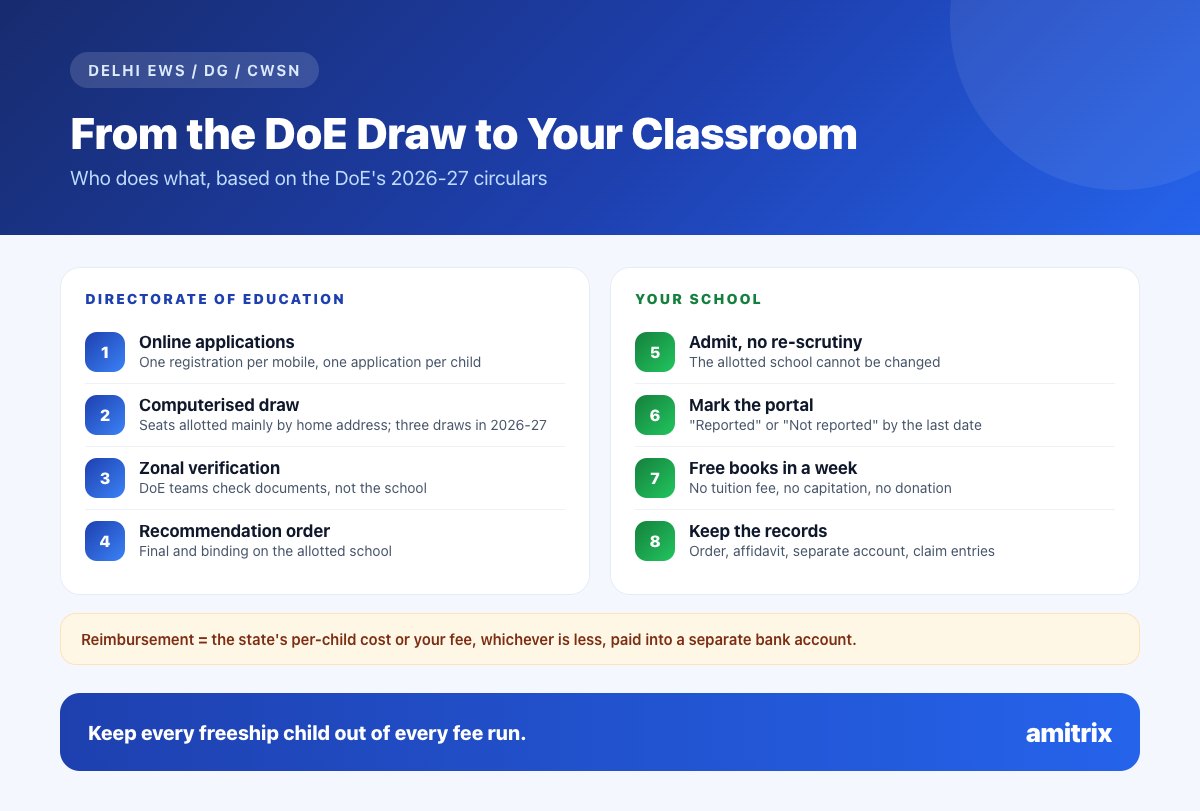
The school does not choose these children, and it does not verify their documents. The process runs through the DoE:
- Families apply online on the DoE portal. One mobile number gives one registration, and a child may have only one application.
- The DoE runs a computerised draw that allots seats mainly by residential address.
- DoE zonal teams verify documents. In 2026-27 there were 29 teams across the districts. Families are told their verification centre by SMS.
- The zone sends recommended children to the allotted school by order. A rejected family gets a reasoned order and can appeal to the District Admission Monitoring Committee.
- The family reports to the school by the last date, and the school records the outcome on the portal.
Seats left empty by rejected or non-reporting candidates go into the next draw. In 2026-27 there were three draws:
| Step | 2026-27 dates |
|---|---|
| Online applications | 21 February to 23 March 2026 (extended from 16 March) |
| First draw | 6 April 2026 |
| Last date to report after the first draw | 20 May 2026 |
| Second draw | 10 July 2026 |
| Final draw | 24 September 2026 |
| Last date to report after the final draw | 31 October 2026 |
The DoE's circulars also note that the 2026-27 allotment is subject to the outcome of a case pending in the Delhi High Court, so watch for further orders.
The Fee Management module shows how RTE and freeship concessions sit on a child's fee plan from the first day, so no invoice goes out by mistake. Book a free demo to see a freeship record set up for your school.
What Your School Must Do Once a Child Is Recommended
The zonal order is final and binding on the school, and the child is not to be scrutinised again. From that point the school's job is administrative, and it is checked:
- Admit the child when the family reports with the zonal order. The allotted school cannot be changed.
- Mark the status on the portal: "Reported" for every recommended child who joins by the last date, "Not reported" for those who don't.
- Charge no tuition fee, and no capitation fee or donation of any kind.
- Provide free books within one week of the child reporting. The DoE's circular also lists uniforms and writing material: since 2023-24 the DoE supplies writing material itself, and since 2025 the Delhi government pays a uniform subsidy directly to students, so check the current circular for what your school must hand over.
- Hold one introduction session for all new parents together, including EWS, DG and CWSN families.
- Keep the paperwork: the zonal order with its set of document copies is meant to be kept on the school's record.
A school that ignores these guidelines can face action under the RTE Act and the Delhi School Education Act and Rules. Complaints about fees charged to EWS students have reached the Delhi High Court, which is one more reason to make sure your fee system can never invoice a freeship child.
Schools on Government-Allotted Land
Some Delhi private schools sit on land allotted by the government, and their obligation is wider:
- they must also admit EWS children for up to 20% of fresh admissions in classes above the entry level, filled by the DoE's separate "EWS/Freeship" draw for Class 2 onwards (in 2026-27, applications ran from 8 to 20 September and the draw was held on 24 September);
- under the Delhi RTE Rules, they continue free education beyond the elementary stage, up to secondary or senior secondary;
- they receive no reimbursement to the extent of this land-linked obligation.
If your school is on allotted land, check the conditions of your allotment and the current DoE circulars before planning fee income for the coming session.
Fee Reimbursement and the Records Behind It
Under Section 12(2) of the RTE Act, the government reimburses the school the state's per-child expenditure or the fee the school actually charges, whichever is less. The Delhi RTE Rules require the school to keep a separate bank account for this money.
How the claim has worked in Delhi, according to Samagra Shiksha Delhi's reimbursement note:
- The school enters its EWS and DG students in the DoE's online module.
- It submits a signed copy of the online report to the zonal office.
- A nominee checks that the children are physically present.
- The zone approves the claim and the district sanctions it.
- The money goes directly to the school's separate account.
The rate: the latest rate we could confirm in an official document is from 2018-19: ₹2,242 per child per month for Classes 1 to 5 and ₹2,225 for Classes 6 to 8. Newer rates are notified by the DoE, so use the figure in the current circular rather than an old number.
Records to keep for every freeship child
- the zonal recommendation order and the attached document copies;
- the "Reported" or "Not reported" status as marked on the portal;
- the EWS family's yearly income self-declaration on affidavit, which the rules require to keep the free seat (a child cannot be removed for missing it without the Director's prior approval);
- proof that books were given within a week;
- the entries made in the reimbursement module and the bank statements of the separate account;
- class attendance, which is good practice even where it is not formally required, because the claim includes a physical check.
A child can use the entry-level EWS/DG/CWSN benefit only once, so a clean record also protects the school if a family's earlier admission comes to light.
Planning for 2027-28
The DoE has not yet announced the 2027-28 schedule. Based on 2026-27, expect:
| Expected | What to prepare |
|---|---|
| February 2027 | Admission notice and the online application window. Check the entry-level class details the DoE holds for your school |
| March 2027 | Applications close |
| April 2027 | First draw, then zonal verification and reporting |
| July and September 2027 | Further draws for vacant seats |
Two more things to settle before February:
- Fee set-up for 2027-28. Under Delhi's 2025 fee law, your fee structure is reviewed by a committee that includes parents. Keep freeship children clearly outside every fee head, so your reports to the committee and to the DoE agree.
- Unified District Information System for Education Plus (UDISE+) entries. Nursery and Class 1 entrants are new to the national student database. Our UDISE+ student module guide explains how to add them correctly.
How Amitrix Helps with EWS and DG Admissions
Amitrix EMS does not replace the DoE portal, where the draw, verification and reporting happen. It keeps the school's own side in order:
- Freeship on the fee record from day one: RTE and EWS concessions are applied to the child's fee plan, so no invoice or fee reminder goes to a freeship family
- Admission tracking: each child's status from enquiry to admission, with document uploads attached to the record
- One parent login for siblings, plus school-wide announcements and teacher–parent messages
- Reports in Excel or PDF: freeship children by class, for reimbursement claims, fee committee papers and DoE requests
- Attendance with absence alerts, giving you a clean record for every child
- Price: one flat ₹12,000 a year for unlimited students, with every module included, as shown on our pricing page
See how it fits the rest of the Delhi school year on our school ERP for Delhi page, or read the Delhi buyer's checklist before you choose any system.
We'll show you a freeship child's record, from admission to reimbursement report, on your own data.
Book a free Amitrix demo →Frequently Asked Questions
What is the income limit for EWS admission in Delhi?
The family's total annual income from all sources must be below ₹5 lakh, and the family must live in Delhi. The limit was set by a DoE notification of 23 December 2024. DG and CWSN applicants do not need an income certificate.
Does a private school verify EWS documents in Delhi?
No. Documents are verified by DoE zonal teams. The zone then sends the recommended child to the allotted school by order, and the school must admit the child without scrutinising the documents again.
What must a school provide free to EWS and DG students?
No tuition fee may be charged. The DoE's circular asks schools to provide free books within one week of the child reporting; writing material is now supplied by the DoE and the uniform subsidy is paid to students directly, so check the current circular for your school's share.
How do private schools get reimbursed for EWS students in Delhi?
The school enters its EWS and DG students in the DoE's online module, the zonal office verifies the claim, including a physical check of the children, and the money is paid into a separate bank account the school keeps for reimbursement. The amount is the state's per-child cost or the school's fee, whichever is less.
Do schools on government land have extra EWS obligations?
Yes. Schools on government-allotted land must also admit EWS children for up to 20% of fresh admissions above the entry level, through the DoE's freeship draw, and continue free education beyond the elementary stage, without reimbursement for that land-linked obligation.
When will Delhi EWS admission for 2027-28 start?
The schedule has not been announced. Based on the 2026-27 cycle, the notice and applications are expected around February 2027, with the first draw around April 2027.
Conclusion
Delhi EWS admission asks little of a private school's judgment and a lot of its administration. The DoE allots and verifies; the school admits, marks the portal, hands over books on time, keeps freeship children out of every fee run, and holds the records that its reimbursement and its reputation depend on.
Get those routines set before the 2027-28 notice arrives in February, and the reserved seats become one more well-run part of admission season rather than its biggest risk.
Want freeship records that run themselves? Book your free Amitrix demo today.