
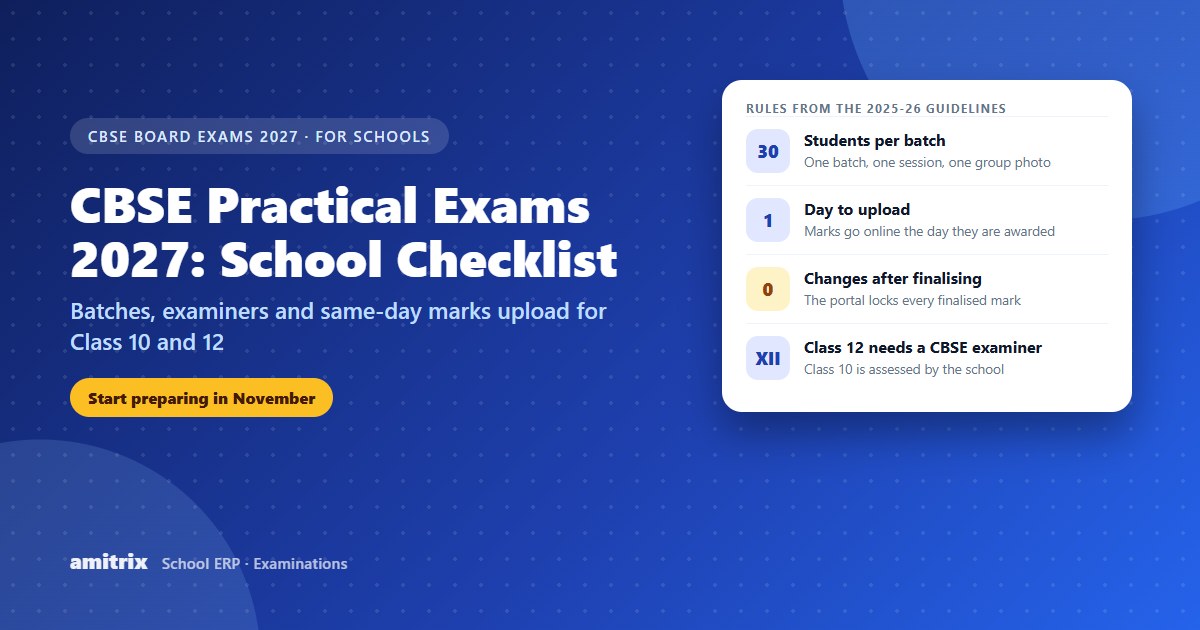
In short: For the 2027 board exams, CBSE schools will conduct Class 10 and Class 12 practical exams, projects and internal assessment themselves and upload every mark on CBSE's portal on the day each assessment happens. Last session the window was 1 January to 14 February, and nothing could be changed once a mark was finalised. Class 12 practicals need an external examiner appointed by CBSE; Class 10 is assessed entirely within the school.
Leaving practical marks for the last days of the window is a mistake CBSE has already had to chase schools about. In a reminder dated 10 February 2026, four days before last session's deadline, it wrote that about 30% of schools had still not finished conducting or uploading their practical and internal-assessment marks.
Those marks count towards the board result exactly as the theory paper does. Yet they're the one part of the board exam a school runs on its own premises, with its own staff, under deadlines it can't move, and a week lost to a missing examiner or a wrongly built batch is a week the school doesn't get back.
Sources: CBSE's Guidelines and SOPs for Practical Examinations, Classes X and XII 2025-26, which governed the 2026 exams. CBSE had not issued its practical-exam circular for 2026-27 as of 11 October 2026; where that circular changes anything, it takes priority. Last reviewed 11 October 2026.
When Are the CBSE Practical Exams for 2027?
CBSE has not announced the 2027 practical schedule yet. It usually follows the same pattern each year, so last session's dates are the best guide to what to expect:
| Schools | 2026 | 2027 (expected) |
|---|---|---|
| Regular | 1 Jan to 14 Feb 2026 | Early Jan to mid-Feb 2027 |
| Winter-bound | 6 Nov to 6 Dec 2025 | Nov to early Dec 2026 |
| Circular | Winter-bound schools: 16 Oct 2025; all schools: 1 Dec 2025 | Not issued yet |
Last session's guidelines stated that no extension of the dates would be considered. Plan on the assumption that the 2027 window will be fixed as well.
Winter-bound schools, in cold regions that close for winter in January, finish much earlier, so their preparation can't wait. Regular schools have until the expected early-January start.
Class 10 vs Class 12: What Changes for the School
The two classes follow very different procedures, and mixing them up is a common source of delay.
| Step | Class 10 | Class 12 |
|---|---|---|
| Who marks | The school's own teachers | A CBSE examiner and a school examiner |
| Answer books | The school buys them | CBSE's regional office sends them |
| Marks entry | Fill in an Excel sheet and upload it | Batches of up to 30, one upload per batch |
| Photos | Not required | One group photo per batch, in the lab |
| After the exam | Answer books stay at school | Answer books go to CBSE |
| Award list | Printed and sealed | Signed by both examiners, scanned, sealed |
In both classes, signed award lists stay sealed in the school's strong room for one year after results, and they are not sent to the regional office.
Most Class 10 subjects carry 20 marks of internal assessment, so Class 10 work is mostly a marks-entry exercise. Class 12 is where the logistics are, with examiners, labs, batches and photos to arrange.
Private candidates and students missing from a list
Private candidates' practical marks follow CBSE's own policy under the examination bye-laws, not the school's arrangement, and CBSE issues separate guidelines for them. Tell them early which rules apply.
A student who turns up missing from a subject list is a matter for your regional office, at once. Don't add the student informally.
How Marks Are Split in Common Subjects
The split between theory and the school-assessed part decides how many marks you're responsible for. These figures are from the subject list attached to CBSE's 2025-26 guidelines. CBSE's 2026-27 curriculum keeps 80 + 20 for Class 10 Science and Mathematics (checked on 3 November 2026); check other subjects on CBSE Academic before you plan.
| Subjects | Theory + school part |
|---|---|
| Class 10: Science, Mathematics (Standard), Social Science | 80 + 20 internal assessment |
| Class 12: Physics, Chemistry, Biology | 70 + 30 practical |
| Class 12: Computer Science, Informatics Practices | 70 + 30 practical |
| Class 12: Accountancy, Business Studies, Economics, History | 80 + 20 project |
| Class 12: Mathematics, English Core | 80 + 20 internal assessment |
A Class 12 science student, then, has 90 of their 500 marks in three practicals assessed in your school. The practical also counts on its own. Under CBSE's scheme of examinations and pass criteria, a Class 12 student must score 33% in the theory and 33% in the practical separately, so a careless practical mark can fail a student who did well in the paper. That's why CBSE treats these marks with the same confidentiality as the theory paper, and they must not be disclosed to students or anyone else before results.
Preparing From November: A Month-by-Month Plan
Start in November. A school that starts in January has six weeks for everything, while one that starts in November has time to find and fix problems before the external examiner walks in. Working backwards from an expected 1 January start, this is a realistic order of work for a regular school:
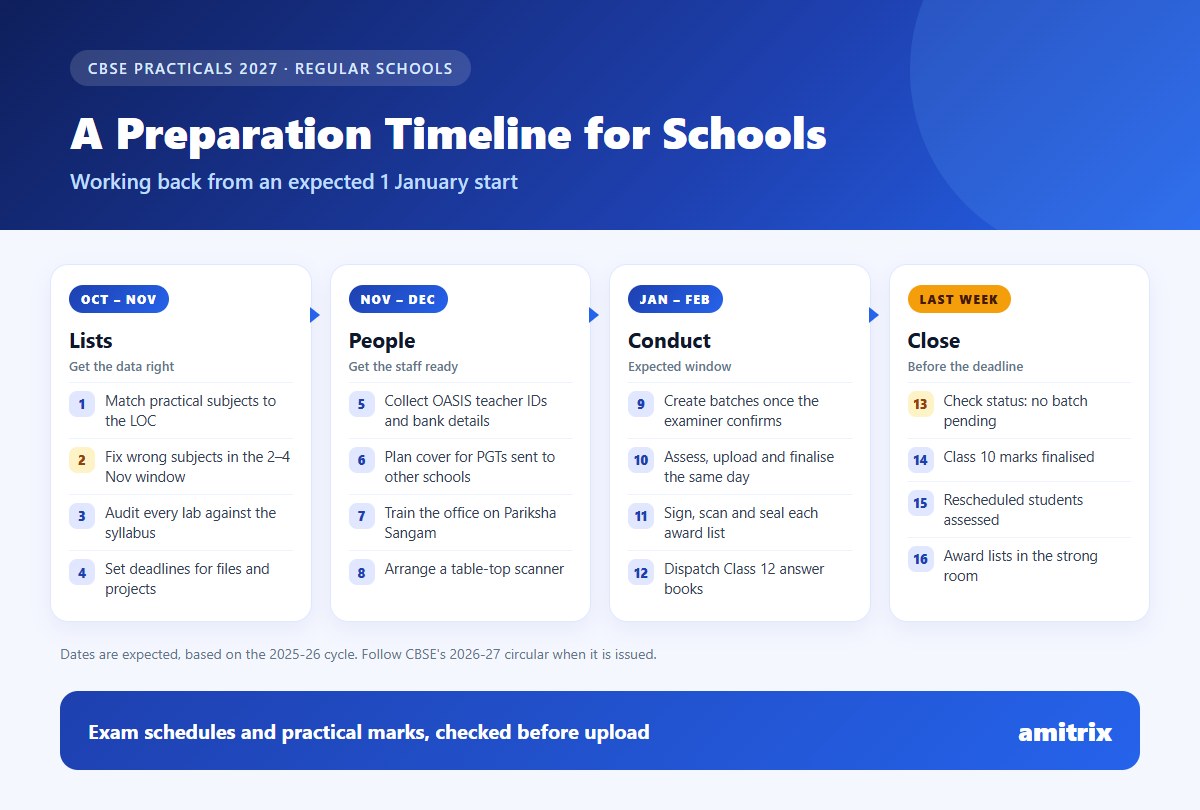
October–November: get the lists right
- Confirm subjects against your List of Candidates (LOC). Practicals are held only for students sponsored through the LOC, and a student missing from a subject list cannot simply be added at the lab door. The CBSE LOC 2027 checklist covers the 2–4 November correction window, the last easy chance to fix a wrong subject.
- Audit every lab. List apparatus, chemicals, specimens and working computers against the practical syllabus, and order consumables now, so shortfalls are fixed before the external examiner's inspection.
- Set internal deadlines for practical files, project reports and investigatory projects, at least two weeks before practicals begin.
November–December: get the people ready
- Collect each teacher's ID on OASIS (CBSE's Online Affiliated School Information System) and their bank details. CBSE uses that teacher ID as the examiner number, and the examiner's name must match their bank account, because all payments go through CBSE's Integrated Payment System.
- Plan for the teachers you'll lose. Your postgraduate teachers (PGTs) may be appointed as external examiners in other schools. CBSE expects you to relieve them, and not relieving them can attract penalties under its bye-laws.
- Train the office on Pariksha Sangam, CBSE's exam portal, from logging in with the LOC credentials to creating batches, uploading marks and printing award lists.
- Arrange a table-top scanner. CBSE asks for signed award lists to be scanned on a proper scanner, not a phone camera.
January to mid-February: conduct and upload
- Create batches only after CBSE sends the external examiner's details and the examiner has confirmed availability. The examiner's details are then locked against the batch.
- Conduct, upload the same day, finalise. Don't hold a batch's marks back to enter later in the week.
- Use the portal's status check each week to see which batches are still pending.
How a Class 12 Practical Day Runs
For one batch of up to 30 students in one subject, the guidelines describe this sequence:
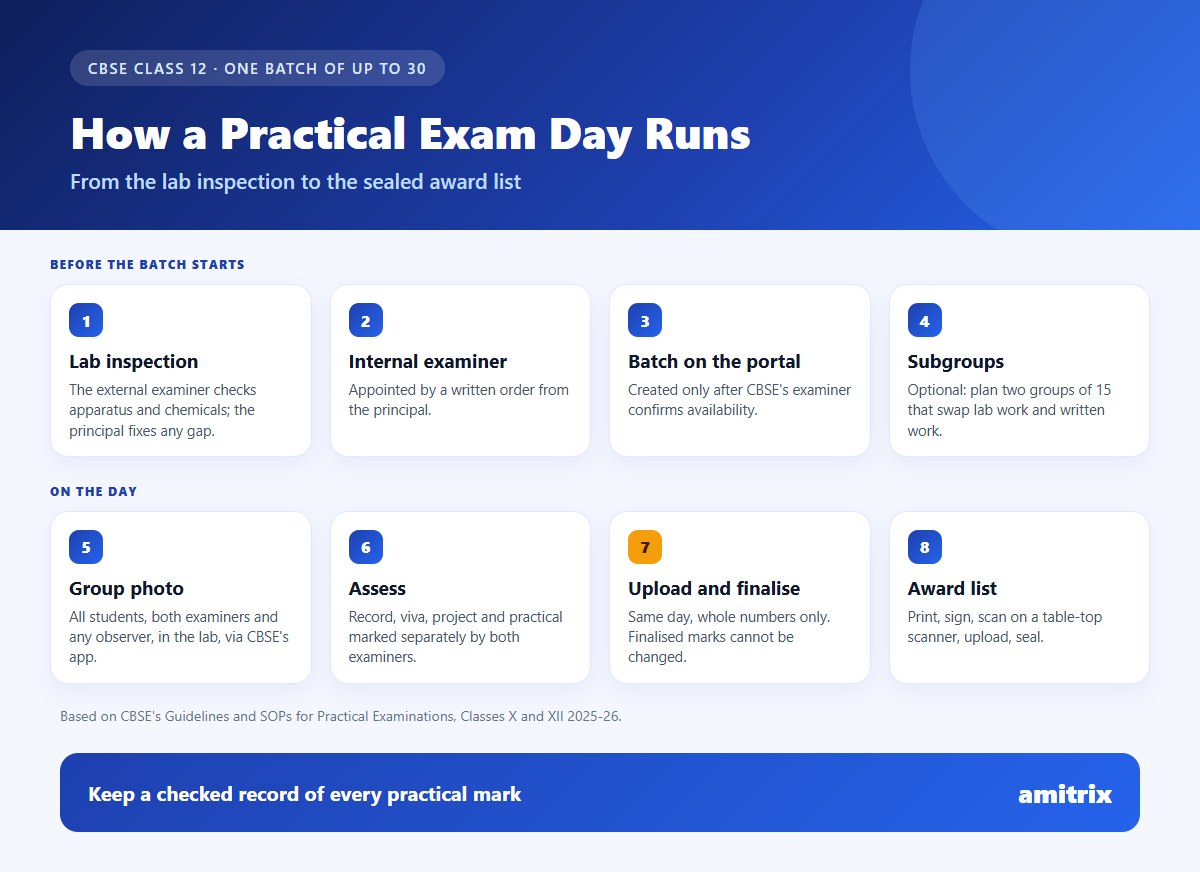
- The day before, the external examiner inspects the lab and reports any shortfall to the principal, who must fix it.
- The principal appoints the internal examiner by a written order naming their duties.
- Split the batch if you need to. CBSE allows two subgroups of 15, one at the lab bench while the other does pen-and-paper work, but the whole batch of 30 must finish the same day.
- Take one group photograph through CBSE's app link, with every student in the batch, both examiners and the observer if one is appointed, and the lab visible. The app records the location and time.
- Mark the answer books. Both examiners agree the experiment and both ask the viva questions, and the record, viva, project and practical marks are shown separately. If the examiners still differ by a mark or two after discussion, they award the average.
- Upload the marks the same day from the school, with both examiners present. Round fractions up, so 25.5 is entered as 26.
- Finalise. After the confirmation pop-up, marks cannot be changed by anyone, and CBSE doesn't accept requests to change uploaded practical or internal-assessment marks, even after the results are out.
- Print one award list and have both examiners sign it. Scan it on a table-top scanner, upload the PDF against the correct batch ID and seal the paper copy for the strong room.
Answer books are then arranged serially and sent to the regional office by insured or registered post. If an examiner sees anything irregular, their report goes to the regional office within three days.
A worked example: planning batches for one school
Take a school with these Class 12 numbers (illustrative figures):
| Subject, students | Batches (max 30) |
|---|---|
| Physics, 112 | 4 (30 + 30 + 30 + 22) |
| Chemistry, 112 | 4 (30 + 30 + 30 + 22) |
| Biology, 48 | 2 (30 + 18) |
| Computer Science, 64 | 3 (30 + 30 + 4) |
| Total | 13 batches |
Each batch is assessed in one session, so 13 batches means 13 sessions. CBSE asks for two or three sessions a day when a subject has more than 30 students, so Physics alone takes two days at two sessions a day. The school's real count is 13 group photographs, 13 award lists to sign and scan, and 13 sets of answer books to dispatch. Knowing that number in November tells you how many examiner-days, lab-days and office hours to block, and why one late upload holds up a whole batch.
Mistakes That Cost Schools Marks or Money
- Leaving uploads to the last fortnight. Last session CBSE removed the option to delete and re-create batches after 14 February, because its payment system opened straight after.
- Creating batches before the examiner is confirmed. The examiner is locked to the batch, so a no-show means going back to the regional office for a new appointment.
- Typing the examiner's name differently from their bank account, or using anything other than their OASIS teacher ID as the examiner number. Their payment details then won't match.
- Entering marks above the subject maximum, or fractions. The preview shows students below the minimum in red and absent students in yellow, so check every row before finalising.
- Scanning award lists with a phone, or uploading a PDF against the wrong batch ID.
- Not relieving PGTs appointed as examiners elsewhere.
CBSE can cancel a school's practical exams if its directions are not followed, and hold them again under its own supervision.
Keeping the Marks Record in Your School ERP Before You Upload
Board marks reach CBSE only through Pariksha Sangam, and Amitrix doesn't upload to it. Where a school ERP helps is the record the office copies from, because portal errors often begin there, as a mark copied from a file, a register or a WhatsApp photo with nothing checking it against the subject maximum.
In the Examinations module of Amitrix, an exam schedule can carry a practical component with separate theory and practical maximums, and teachers enter the two parts separately. A mark above either maximum is refused as it's entered. Marks can also come in from an Excel sheet, with a preview before anything is saved, and each schedule records its date, room and invigilator. Before any of it counts, someone other than the teacher who entered a paper checks it in the ERP, the same habit report card software for CBSE schools should enforce for the school's own exams. The office then copies one checked list into Pariksha Sangam, instead of assembling it from loose sheets on the last day. For how exams sit beside fees and attendance, see school ERP software for the whole school.
Attendance comes before any of this, since a Class 10 or 12 student who falls short may not be allowed to sit the board exam at all. How the CBSE 75% attendance rule is applied, and when a shortfall can be condoned, is a separate topic. Student data security and compliance are covered under Amitrix's features, and the single yearly plan includes the Examinations module along with every other.
Frequently Asked Questions
What happens if a student misses the practical exam?
If the school will retest the student within the notified window, it marks them "Re-scheduled" on the portal and assesses them before the window closes. Otherwise, the student is marked "Absent". CBSE does not allow an assessment after the window, whatever the reason, so any retest has to fit inside it.
Who appoints the external examiner for Class 12 practicals?
CBSE's regional office appoints them, and only an examiner appointed by CBSE may conduct a Class 12 practical, so the school cannot arrange a local replacement. If the examiner doesn't arrive or refuses the duty, the school informs its regional office, which appoints another.
Turn Your Class 12 Numbers Into a Batch Count
For each Class 12 practical subject, divide the number of students by 30 and round up, as in the worked example. Add the sessions that number needs, at two or three a day for any subject with more than 30 students, and hand the total to your exam coordinator now. It decides the examiner-days, lab-days and office hours your January depends on.
To check that the marks you'll copy into Pariksha Sangam are right before the portal opens, see marks entry for a practical subject.