
Picture the office on a Monday morning. A father puts an admission letter from a school in Pune on the counter: his daughter has been given a seat in Class 7, and the new school wants her transfer certificate before it enters her name. He needs it by Friday.
A TC is the school's sworn record of who the child is, what they studied and where they stood on the day they left. CBSE's Examination Bye-Laws give a transfer certificate format with 22 numbered entries (Annexure I), and the admitting school is told to see a TC "in the format given in Annexure I" before the child goes into its admission register. State boards and education departments set their own formats, so a state-board school should check its department's version first.
The 22 Entries in CBSE's TC Format
The entries follow Annexure I's order. The last column says where an office would normally find each answer.
| No. | Entry | Taken from |
|---|---|---|
| 1 | Name of pupil | Admission register |
| 2 | Father's or guardian's name | Admission register |
| 3 | Nationality | Admission form |
| 4 | Whether Scheduled Caste or Scheduled Tribe | Admission form, with certificate |
| 5 | Date of first admission, with class | Admission register |
| 6 | Date of birth, in figures and in words | Admission register only |
| 7 | Class last studied, in figures and in words | Current class record |
| 8 | Last annual exam taken, with result | Result register |
| 9 | Whether failed, once or twice in the same class | Result register |
| 10 | Subjects studied | Class subject list |
| 11 | Whether qualified for promotion, and to which class | Result register |
| 12 | Month up to which school dues are paid | Fee ledger |
| 13 | Any fee concession, and its nature | Fee ledger |
| 14 | Total working days | Attendance register |
| 15 | Working days present | Attendance register |
| 16 | NCC, Scouts or Guides | Activity record |
| 17 | Games and activities, with level reached | Activity record |
| 18 | General conduct | Class teacher |
| 19 | Date of application for the TC | Parent's letter |
| 20 | Date of issue | Office |
| 21 | Reason for leaving | Parent's letter |
| 22 | Any other remarks | Principal |
Above the entries sit a book number, a serial number and the admission number. Below them go the class teacher's signature, the name and designation of whoever checked it, and the principal's signature with the school seal. The note under the format says a TC is signed by the regular principal or vice principal.
Twelve different sources feed one certificate. When each is copied by hand, the TC is only as accurate as the least up-to-date register.
A Filled Sample, and the Entries That Go Wrong
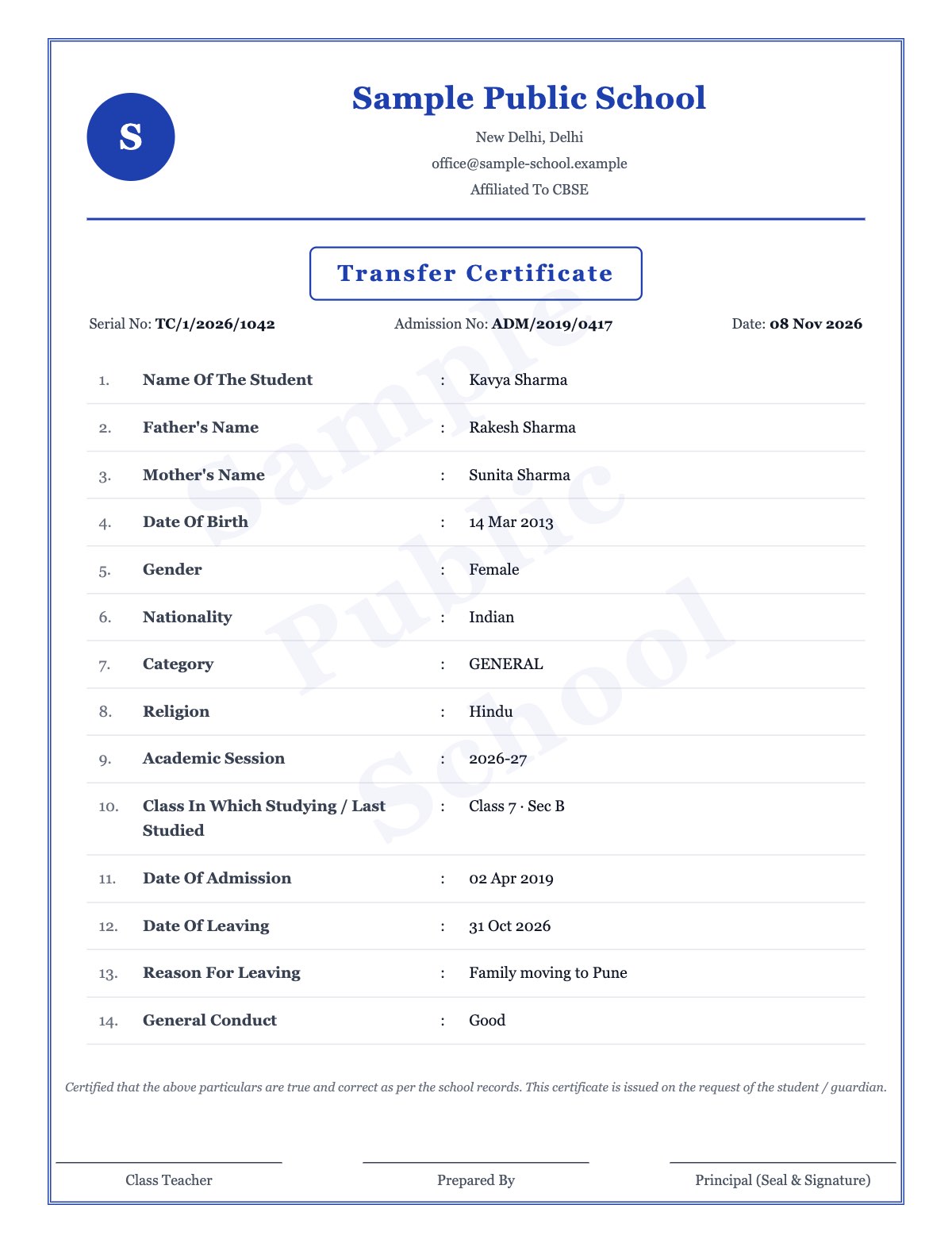
A real transfer certificate produced by Amitrix EMS, filled with sample data: no real school or student. It prints 14 of CBSE's 22 entries, so a CBSE school adds the rest (see "Making TCs From Your School ERP").
Take the girl leaving for Pune as a worked example; the figures are invented. She was admitted on 2 April 2019, leaves on 31 October 2026 from Class 7, and the school had been open on 118 days of the session by then, of which she attended 109. Entry 14 reads 118 and entry 15 reads 109. Holidays and Sundays count towards neither number.
Entry 6 reads "14.03.2013" in figures and "Fourteenth March Two Thousand Thirteen" in words, copied from the admission register and nowhere else. If the birth certificate disagrees with the register, correct the register first, then write the TC, because the admitting school will set this line against the certificate the family brings.
Entry 11 depends on the time of year. A child leaving in October hasn't finished Class 7, so "Not applicable, left during the session" is honest. A child leaving after the annual result should get "Yes, to Class 8", in figures and words.
The other slips that get TCs returned are small and avoidable:
- the admission number changed since admission (CBSE's bye-laws say a student keeps one admission number for their whole time in the school, even after a gap);
- an issue date of 4 November on a TC the father only asked for on 6 November, which tells the new school the dates were filled in afterwards;
- entry 18 filled with the same stock word for every child, whatever the class teacher's record says;
- a duplicate TC that doesn't say "Duplicate";
- the class in words left blank;
- no seal, or a signature from someone other than the regular principal or vice principal.
The Rules Behind a TC
For Classes 1 to 8, the Right of Children to Free and Compulsory Education Act, 2009 decides the timing. Section 5(3) says the head teacher of the school a child is leaving "shall immediately issue the Transfer certificate". It adds that a delay in producing the TC can't be a ground for delaying or denying admission in the new school, and that a head teacher who delays issuing it is liable to disciplinary action under their service rules.
For its own schools, CBSE's rules on admission and transfer of students set four more conditions:
- The admitting school must see a TC in the Annexure I format before entering the child in its admission register.
- No child may be admitted to a class higher than the TC entitles them to.
- A student leaving at the end of a session, or permitted to leave during it, receives the TC "on a payment of all dues".
- Once a student's name has been sent up for the board exam, they can't move to another school that session unless the Chairman allows it in special circumstances.
The TC is also only one of three records that move. On UDISE+ the leaving school marks the child as gone with a TC so the new school can import the same record, as the UDISE+ student module guide explains step by step, and the APAAR ID travels with the student rather than being issued again. A TC carries a child's date of birth, category and parents' names, so share it only with the family and the new school; the DPDP duties a school carries cover it like any other student record.
Checked on 8 November 2026 against three documents: section 8 and the TC layout (Annexure I) in the 2004 edition of CBSE's Examination Bye-Laws; CBSE's letter Coord/ROs/Admission-IX-XI/2019, sent to schools on 18.07.2019 about pupils moving in Class 9 or 11; and the transfer clause of the RTE Act, Section 5, in its Gazette text of 27.08.2009.
Making TCs From Your School ERP
In a school ERP the TC should be the last step of a record that's already right, not a form typed from three registers. In Amitrix, the principal or an admin marks the student as "TC issued" from the student directory on the website or the student's profile in the Android app, with the leaving date and the reason. The same step switches off the student's login, closes their chats and cancels bills that are still completely unpaid. Bills that are partly paid stay on the record, so the dues entry can be checked against the fee ledger.
The TC then downloads as a PDF with a serial number in the form TC/school/year/student, the admission number, and the name, date of birth, gender, both parents' names, nationality, category, religion, session, class and section, date of admission, date of leaving and reason, all taken from the student's profile. That's the sample above.
It isn't yet CBSE's full Annexure I layout, and a CBSE school should know where the gaps are:
- it has no lines for subjects, the last exam and result, promotion, failed attempts, dues month, concession, working days, days present, NCC or activities, the date of application, or other remarks;
- date of birth and class are printed in figures only;
- general conduct prints as "Good" for every student, so cross it out where the class teacher's record says otherwise;
- category prints as the stored code (for example "GENERAL");
- the date at the top is the day the PDF is downloaded, so download it once and keep that copy rather than reprinting later.
Attendance, results and fee records are all in the same system, so the missing entries can be read off one screen each. Today, though, the office writes them in by hand. The rest of the student record, from admission to leaving, is set out stage by stage, and choosing a whole school ERP goes through fees, exams and the rest. The TC sits with admissions in the module list.
We'll mark one sample student as leaving and download the certificate with you.
See a TC come out of a student's record →Frequently Asked Questions
Can a school hold back a TC because fees are unpaid?
For Classes 1 to 8, the RTE Act's demand for an immediate TC settles it. CBSE's bye-laws give the TC "on a payment of all dues", but entry 12 exists so that unpaid months can be written on the certificate. Courts have leaned the same way: in news reports from 2019 and 2021, the Delhi High Court and the Bombay High Court's Nagpur bench told private schools not to hold back a TC over unpaid fees. The safer course is to issue the TC, record the dues on it, and recover them separately.
Is a duplicate TC allowed when the original is lost?
Issue a duplicate once the principal is satisfied the original is lost, and mark it "Duplicate" clearly, as CBSE's bye-laws require. It helps to note the reissue in the TC book against the original serial number, so both copies can be traced.
Does a TC from another CBSE school need to be countersigned?
Not any more. CBSE's circular of 18 July 2019 on changing school in Class 9 or 11 says a TC issued by a CBSE school shouldn't be sent to CBSE for verification or countersignature, and points schools to its TC uploading circular of 1 October 2018. A TC from a school under another board still needs countersigning by that board's education authorities before a CBSE school admits the child to Class 10 or 12. The countersigning note printed under Annexure I predates that change.
Before the Next TC Request Reaches the Office
Take the last three TCs your school issued and set each one beside the 22 entries above. Note every blank line, then check the date of birth on each against the admission register. If a line keeps coming back blank, the fix belongs in the record that feeds it, not on the certificate.
Walk through it with us on your own student list when you'd like to see the TC beside the records it's built from.